For years, investors have viewed Anant Raj as a traditional real estate developer. Today, however, the company stands at the intersection of two powerful themes shaping India’s future—real estate and data centers.
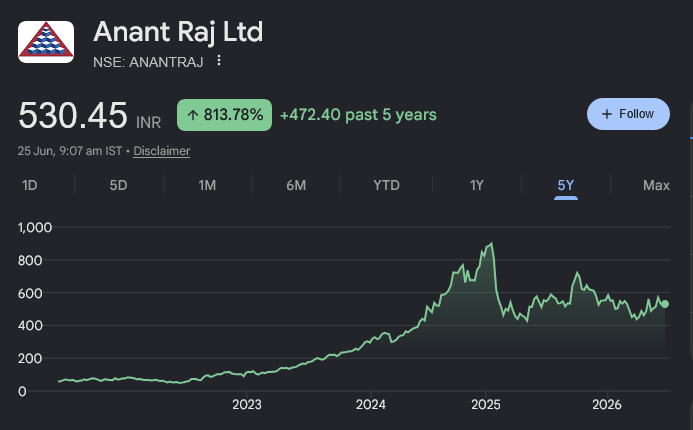
The stock has already delivered extraordinary wealth creation, rising nearly 800% over the last five years. Yet despite this stellar performance, the stock has remained largely flat over the past year, leading many investors to wonder whether the next growth phase is still ahead.
Global brokerage Nomura believes the answer is yes.
Nomura Maintains ‘Buy’ Despite Target Price Cut
Nomura has retained its ‘Buy’ rating on Anant Raj while reducing its target price from ₹700 to ₹650 per share. The revised target still implies an upside potential of around 24% from recent levels.
The brokerage’s target cut is not due to any deterioration in the long-term business outlook. Instead, it reflects near-term delays in the ramp-up of the company’s cloud infrastructure business and slower-than-expected launches of residential projects.
Despite these temporary setbacks, Nomura remains constructive on the company’s growth prospects.
Data Centers: The New Growth Engine
What makes Anant Raj particularly interesting is its growing presence in the data center and cloud infrastructure segment.
As India’s digital economy expands, demand for data storage, cloud computing, artificial intelligence, and enterprise IT infrastructure continues to rise sharply. Anant Raj is positioning itself to capitalize on this opportunity through its data center business.
However, the monetization cycle in this segment is proving slower than expected.
According to management, once cloud infrastructure is installed, it typically takes 4-6 months for testing, validation, and customer handovers before rental income begins to flow. This has delayed revenue recognition from newly commissioned capacity.
As a result, Nomura has trimmed its earnings estimates for FY27 and FY28.
Cloud Capacity Expansion Slower Than Expected
The brokerage now assumes annual cloud capacity additions of 3 MW instead of its earlier estimate of 4 MW.
Consequently, the cloud business is expected to contribute about 10-11% of total revenues, lower than Nomura’s earlier expectation of 13-14%.
Even this revised estimate remains significantly below management’s long-term aspiration of achieving a 25% cloud revenue mix.
While the pace may be slower than anticipated, the direction remains intact.
Rental Income Continues to Accelerate
The encouraging part is that rental income from data centers continues to grow rapidly.
Data center rental income surged to ₹74 crore in the fourth quarter of FY26 compared with just ₹17 crore in the corresponding quarter last year. It was also substantially higher than the ₹44 crore reported in the previous quarter.
Annualizing the fourth-quarter run rate alone would imply FY27 rental income of approximately ₹296 crore compared with ₹176 crore in FY26.
Nomura expects an additional 1.5 MW of cloud capacity to begin generating rental income from the second quarter of FY27. Since every 1 MW of cloud capacity can generate approximately ₹150 crore in annual rental revenue, the newly operational capacity could contribute around ₹170 crore over the next nine months.
As a result, the brokerage estimates data center rental income could reach ₹580-600 crore during FY27.
This highlights the significant earnings potential embedded in the business once capacities are fully operational and customer onboarding is completed.
Growth Remains Strong Despite Moderation
Nomura expects Anant Raj’s EBITDA to grow at a healthy CAGR of 30-35% between FY26 and FY29.
While this is lower than the blistering 50% EBITDA CAGR achieved during FY23-FY26, it still represents one of the strongest growth profiles within the real estate sector.
Importantly, future growth is expected to come from both the real estate and data center businesses, creating a diversified earnings stream.
Real Estate Business Provides Stability
While investors are increasingly excited about the data center opportunity, Anant Raj’s core real estate business remains a major value driver.
The company is expected to launch its luxury housing project, Group Housing-2 (GH2), during the second quarter of FY27 after obtaining necessary approvals.
Another major residential development, GH3 in Gurugram, is also progressing through the approval process.
These projects are expected to generate substantial cash flows over the coming years.
₹2,500 Crore Free Cash Flow Opportunity
One of the most attractive aspects of the investment case is the cash generation potential from the residential business.
Nomura estimates that ongoing residential projects could generate approximately ₹2,500 crore of free cash flow.
This provides the company with significant financial flexibility to fund future data center expansion while maintaining balance-sheet strength.
The real estate segment effectively acts as a cash-generating engine, while the data center business offers high-growth optionality.
The Investment Thesis
Anant Raj offers investors exposure to two powerful long-term themes:
- India’s growing demand for premium residential real estate.
- The rapid expansion of data centers and cloud infrastructure.
The market’s near-term concern revolves around delays in cloud capacity monetization and project launches. However, these issues appear more timing-related than structural.
With data center rental income rising sharply, multiple residential projects in the pipeline, and substantial free cash flow generation expected from ongoing developments, the company remains well positioned for the next phase of growth.
For investors looking beyond short-term execution delays, Anant Raj represents a rare opportunity to participate in both India’s real estate cycle and its digital infrastructure buildout through a single company.
That combination is precisely why leading brokerage Nomura continues to maintain a Buy rating despite reducing its target price.
This version is written in a financial-news style suitable for publication on investment websites, newsletters, LinkedIn, or stock market blogs.