Prashant Jain’s 3P Investment Managers has acquired a 2.5% stake in Entero Healthcare Solutions for around ₹150 crore, drawing fresh investor attention to one of India’s rapidly scaling healthcare distribution platforms. The transaction, reported on August 24, 2026, comes at a market capitalisation of roughly ₹7,155 crore and has sparked renewed interest in the company’s technology-led approach to pharma distribution. Entero’s shares subsequently gained sharply, reflecting positive market sentiment around the investment.
But beyond the headline transaction, the more interesting story is the business model.
Entero Healthcare: Connecting Pharma Companies With the Last Mile
Entero Healthcare operates in the business of distributing pharmaceutical and healthcare products from manufacturers to retail pharmacies, hospitals and other healthcare institutions.
The opportunity exists because India’s pharmaceutical distribution market remains highly fragmented. Entero’s earlier industry disclosures highlighted the presence of more than 65,000 distributors and over 9 lakh retailers, with traditional/local distributors accounting for the overwhelming majority of the market.
This fragmentation creates an opportunity for a scaled player to become a single-point aggregator.
Instead of a pharmacy or hospital dealing with multiple distributors for different products, Entero aims to provide a broad range of products through one integrated platform. For manufacturers, the proposition is equally attractive: instead of building a distribution network market-by-market, they can leverage Entero’s existing infrastructure and customer relationships.
That creates a two-sided network connecting:
Pharma & healthcare manufacturers → Entero → Pharmacies / Hospitals
Why the Aggregator Model Is Interesting
The key attraction of Entero’s model is not simply that it sells medicines.
It is the ability to aggregate fragmented supply and fragmented demand.
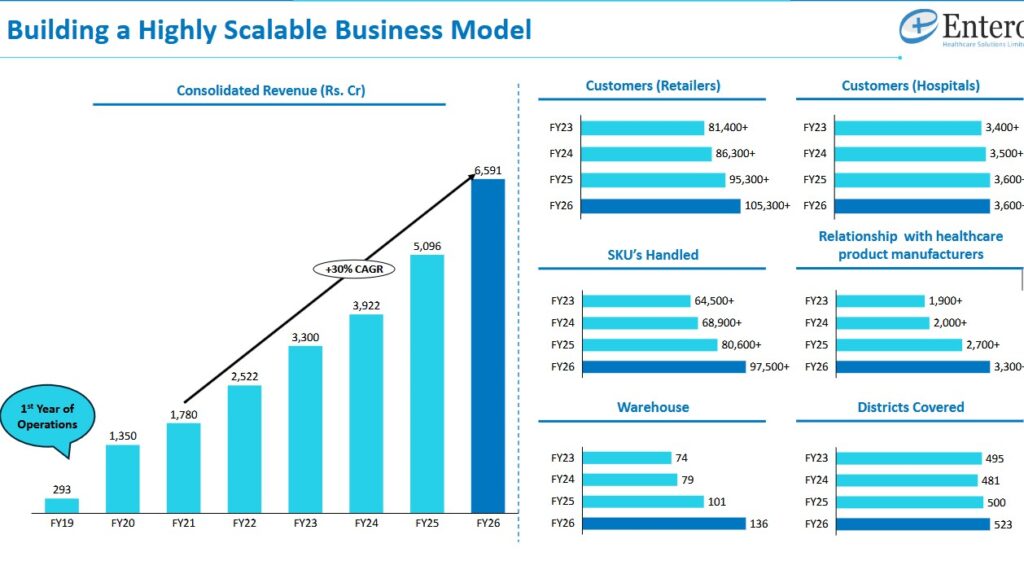
Entero’s FY25 annual report showed a network of approximately 95,300 retail pharmacies, 3,600+ hospitals, 2,700+ manufacturers and 80,600+ SKUs, supported by 101 warehouses across 20 states.
As the network becomes larger, several advantages can potentially emerge:
- More manufacturers can be onboarded.
- Pharmacies get access to a wider product basket.
- Hospitals can reduce the number of vendors they need to manage.
- Inventory can potentially be deployed more efficiently.
- Delivery infrastructure can be utilized across a larger customer base.
- Technology can make ordering, inventory management and reconciliation more efficient.
- Entero can gain greater wallet share from existing customers.
This is where the scale economics of the business become important.
Technology Is the Differentiator
At first glance, pharmaceutical distribution can look like a traditional, low-margin logistics business.
Entero is attempting to change that perception through technology.
Its digital platform integrates ordering, inventory visibility, order tracking, payments, returns, claims and other functions. The company’s technology infrastructure is also connected with its warehouse and ERP systems, allowing inventory information to be updated in real time.
For retail pharmacies, Entero Direct provides a single interface for viewing product availability, pricing, promotional schemes and credit information.
For hospitals, the platform provides online ordering, inventory visibility, order management, tracking and returns/claims processing.
The larger opportunity is that technology can turn a conventional distributor into a data-enabled healthcare supply-chain platform.
That data can potentially help manufacturers understand demand patterns, improve product availability and strengthen their engagement with the distribution channel.
A Highly Scalable Model?
This is arguably the most important part of the investment thesis.
Entero’s FY25 revenue from operations reached approximately ₹5,096 crore, up 30% year-on-year. EBITDA increased 53% to ₹172 crore, while PAT rose 170% to ₹107 crore. The company also reported gross-margin expansion from 9.0% to 9.5%.
The combination of revenue growth and operating leverage is worth watching.
The company has also used acquisitions as a growth accelerator. During FY25, Entero completed 10 strategic acquisitions, which contributed more than ₹792 crore of annualized revenue, according to its annual report.
The strategy is relatively straightforward:
Acquire local distributor → integrate operations → add products/customers → introduce technology → improve scale → repeat.
In a fragmented industry, this consolidation strategy can potentially create a flywheel.
Why Prashant Jain’s Investment Matters
Prashant Jain is one of India’s best-known long-term investors, and therefore his investment through 3P Investment Managers is likely to attract significant attention.
The acquisition of a 2.5% stake for around ₹150 crore suggests that the investor sees potential in Entero’s long-term positioning within India’s healthcare supply chain.
Importantly, the investment should not automatically be interpreted as a guarantee of future stock performance.
Rather, it can be viewed as a signal that the business model deserves closer examination.
The core thesis appears to revolve around three structural themes:
Fragmentation → Consolidation → Technology-led scale
If Entero can continue gaining market share while maintaining disciplined working-capital management and improving margins, the company could potentially transition from being viewed purely as a distributor to being valued as a scaled healthcare supply-chain platform.
The Opportunity Is Bigger Than Pharmaceuticals
Another interesting aspect is that Entero is expanding beyond conventional medicines.
Its product portfolio includes pharmaceuticals, medical devices, consumables and other healthcare products. Its hospital business, for example, includes medical devices and hospital consumables alongside pharmaceutical products.
This creates the possibility of increasing share of wallet from existing customers.
A pharmacy that initially buys medicines through Entero could potentially purchase a much wider basket of healthcare products.
Similarly, a hospital could consolidate procurement across pharmaceuticals, medical devices and consumables.
That is strategically important because increasing revenue per customer can be more efficient than acquiring an entirely new customer.
What Could Make the Story Work
The investment thesis can be summarized in five points:
1. Huge fragmented market
India’s healthcare distribution ecosystem remains dominated by thousands of local distributors, leaving room for organized players to consolidate the market.
2. One-stop procurement
Entero can aggregate products from thousands of manufacturers and offer them to pharmacies and hospitals through a single platform.
3. Technology-led execution
Digital ordering, inventory visibility, analytics and ERP integration can improve the efficiency of a traditionally fragmented supply chain.
4. Acquisition-led consolidation
Acquiring regional distributors provides a relatively fast route to geographic expansion and customer acquisition.
5. Operating leverage
As revenue scales across the existing infrastructure, improvements in procurement, logistics and fixed-cost absorption could support margin expansion.
But Investors Should Watch the Risks
The story is attractive, but it isn’t risk-free.
Pharmaceutical distribution is traditionally a working-capital-intensive and low-margin business. Entero itself reported net operating working-capital days of 70 days in FY25, up from 67 days, partly reflecting newly acquired businesses.
Investors therefore need to monitor:
- Working-capital requirements
- Debt and finance costs
- Cash-flow conversion
- Acquisition integration
- Margin expansion
- Competitive intensity
- Returns on capital
- Regulatory changes
- Whether organic growth remains strong after acquisitions
A high-growth distribution company can create substantial shareholder value, but only if growth does not require disproportionately large amounts of capital.
The Bigger Picture
The interesting part of Entero Healthcare is that it is operating at the intersection of healthcare, distribution, technology and consolidation.
India has a massive pharmaceutical ecosystem, but its distribution infrastructure remains fragmented. Entero’s strategy is essentially to build an organized national layer between manufacturers and healthcare providers.
If successful, the company could benefit from a virtuous cycle:
More manufacturers → wider product range → more pharmacies/hospitals → greater purchasing scale → better supply-chain efficiency → stronger customer proposition → more manufacturers and customers.
That is the essence of the scalable business-model thesis.
Prashant Jain’s 3P Investment Managers acquiring 2.5% for approximately ₹150 crore therefore brings attention to a company attempting to solve a genuine structural problem in Indian healthcare distribution.
At a market capitalisation of around ₹7,155 crore, the key question for investors is no longer simply whether Entero can grow revenue.
The bigger question is whether it can convert scale + technology + consolidation into sustainable free cash flow and improving returns on capital.
If it can, Entero could evolve from being just another pharma distributor into an important technology-enabled backbone of India’s healthcare supply chain.