Opportunities Beyond Volatility With Focus On Quality
Indian equities enter November after a volatile October in which the Nifty 50 recovered and ended the month higher, while mid- and small-cap indices remained under pressure. The sharp divergence between large caps and the broader market highlights a continued preference for liquidity, earnings visibility, and relatively defensible balance sheets. The Nifty IT index was a notable outperformer, rising 17.7% in October, supported by better sentiment towards AI monetisation and more reasonable valuations after its earlier correction. At the same time, Brent crude rose to around US$117 per barrel, foreign portfolio investors remained net sellers, and the US 10-year yield stayed close to 5%, limiting the scope for a broadbased re-rating. In October, the Nifty 50 inched up by 1.9%, while the Nifty Midcap 100 fell 3.04%, Nifty Smallcap 250 declined by 5.8%, and Nifty 500 dropped 2.9%.
November- Constructive but Selective
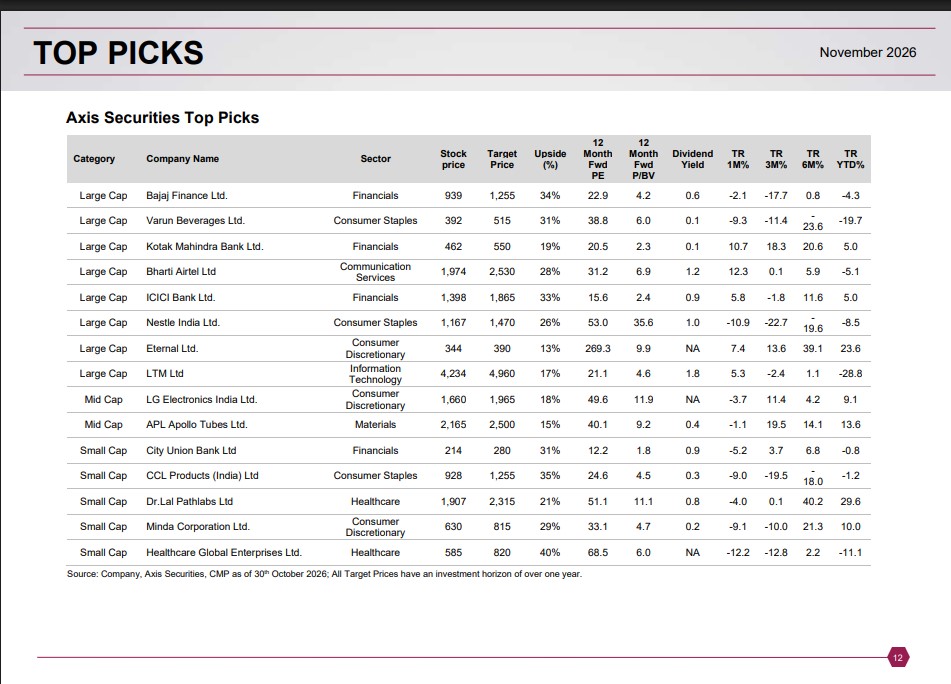
For November, our stance is constructive on a selective basis. Domestic growth remains resilient; Q2FY27 results have so far been broadly steady, and domestic institutional flows continue to provide support. Nevertheless, the combination of elevated energy prices, a deficient monsoon, persistent external uncertainty, and a valuation premium over emerging markets argues against indiscriminate buying. We prefer businesses with sustainable earnings growth, strong balance sheets, reasonable valuations, and the ability to protect margins.
Q2FY27 Earnings: Resilience and Constructive
The Q2FY27 earnings season has been broadly resilient so far, with several companies reporting results in line with or ahead of expectations. Till date 35 Nifty50 companies have reported earnings growth of 21% YoY The market response, however, has been highly stock- and sector-specific. Management commentary on demand, order execution, pricing, wage and input costs, capex plans and FY27 guidance will be as important as the reported quarter. The more important tests are the proportion of companies beating estimates, the breadth of revenue growth, operating margin movement, and working-capital discipline.