Rising Interest Rates: A Warning Signal for the Stock Market
The stock market’s direction is influenced by several factors, but interest rates remain one of the most important. When central banks raise rates to control inflation or maintain economic stability, the resulting increase in borrowing costs can affect businesses, consumer spending, corporate profitability, and investor sentiment.
Veteran investor Ashish Kacholia recently shared a brief but significant observation on X (formerly Twitter), suggesting that rising interest rates could indicate the possibility of a bear market.
The discussion began when a user, Apurva (@Ars3286), asked whether the concern was relevant in the current market environment and whether the prevailing conditions should be classified as a bull market, a bear market, or a correction within a bull market.
Kacholia responded:
“Rising interest rates means probably a bear market.”
Although the statement is brief, it highlights an important macroeconomic risk that investors should not overlook: a sustained rise in interest rates can fundamentally change the way financial markets value businesses.
Why Do Rising Interest Rates Matter?
Interest rates influence the economy through several channels. Higher rates generally increase the cost of loans, make debt financing more expensive, and can reduce the attractiveness of investments that depend on strong future earnings growth.
When borrowing becomes more expensive, companies may postpone expansion plans, reduce capital expenditure, or spend a larger portion of their earnings servicing debt. Businesses with high leverage and limited pricing power can be particularly vulnerable.
The impact can extend beyond corporate balance sheets. Higher interest rates may also encourage investors to move money towards fixed-income instruments, such as bank deposits and bonds, especially when the returns on these alternatives become more attractive relative to the risks associated with equities.
Consequently, stocks may face pressure from two directions: potentially slower earnings growth and lower valuations.
From the US Federal Reserve to the RBI: Why Monetary Policy Matters
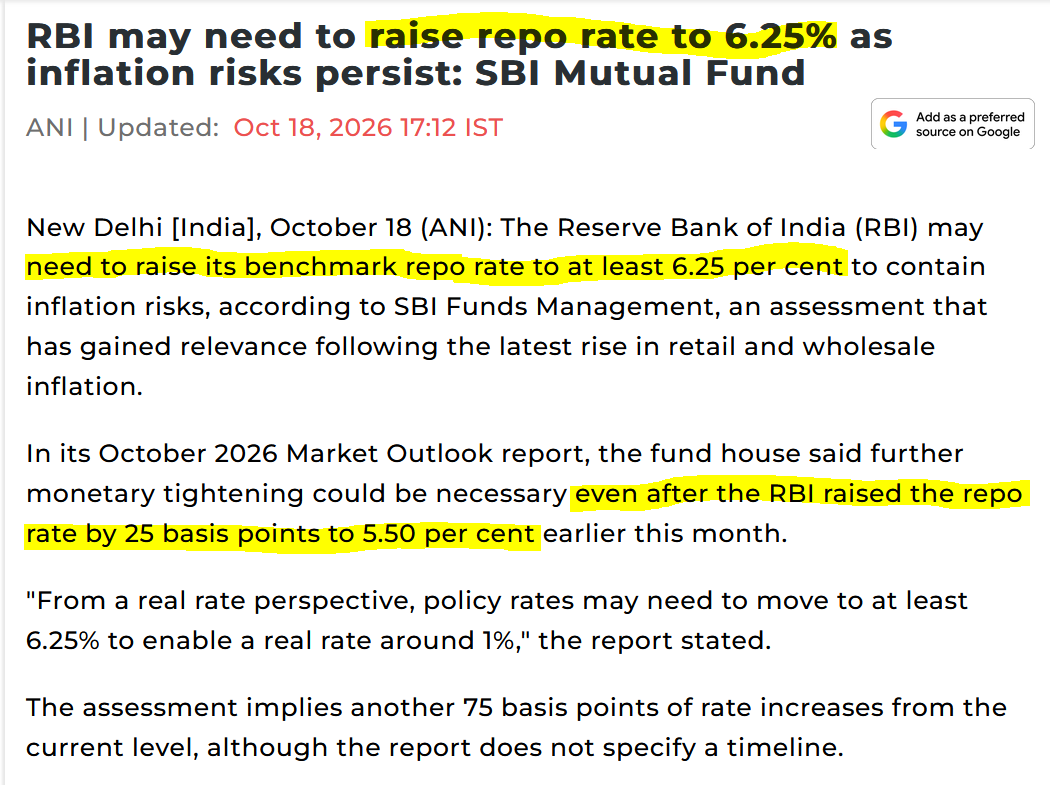
According to the interest-rate figures cited in the discussion, the US Federal Reserve raised its policy rate by 25 basis points, while the Reserve Bank of India (RBI) increased the repo rate from 5.25% to 5.50%.
A basis point represents one-hundredth of a percentage point. Therefore, a 25-basis-point increase is equivalent to 0.25 percentage points.
The possibility of further RBI tightening, with some market observers suggesting a repo rate of 6.25% or higher, raises questions about the potential consequences for Indian equities.
However, such a level should be viewed as a forecast or opinion rather than an established policy requirement. The RBI’s actual decisions depend on inflation, economic growth, liquidity, currency conditions, and other domestic and global considerations.
The direction of US monetary policy can also influence global financial conditions. Changes in US interest rates may affect capital flows, bond yields, the dollar, and investor appetite for emerging-market assets. Nevertheless, the RBI does not automatically have to mirror every Federal Reserve move; India’s monetary policy is determined by its own economic circumstances and policy objectives.
For equity investors, the critical question is not simply whether interest rates rise, but how far they rise, how long they remain elevated, and whether markets have already priced in those developments.
How Higher Interest Rates Can Hurt Corporate Profits
The first major risk from rising interest rates is the potential squeeze on corporate earnings.
Companies that rely heavily on borrowing may experience higher interest expenses when their loans are repriced or refinanced. This can reduce net profit even if revenue remains relatively stable.
Businesses may also face weaker demand as consumers and other companies become more cautious about spending. Sectors dependent on financing, such as real estate, automobiles, infrastructure, and capital-intensive industries, can be particularly sensitive to borrowing costs.
The impact, however, will not be uniform across the market.
Companies with strong balance sheets, low debt, healthy cash flows, and the ability to pass on higher costs to customers may prove more resilient. Businesses with substantial debt, weak cash generation, or valuations that assume aggressive future growth may face greater pressure.
This distinction becomes especially important when investors assess smaller companies and high-growth stocks, where expectations about future profitability can account for a significant portion of their market value.
Why Rising Rates Can Trigger a Valuation Reset
Even when a company continues to grow its earnings, its stock price can decline if investors become unwilling to pay the same valuation multiple.
This happens because the value of a business depends not only on how much money it earns but also on the expected return investors demand for owning it.
When interest rates rise, the return available from relatively safer investments may increase. Investors may consequently demand higher returns from equities, reducing the amount they are willing to pay for each unit of expected corporate earnings.
For example, a stock trading at 50 times its annual earnings may become less attractive if interest rates rise, growth expectations weaken, or the perceived risk of the business increases. Investors may then be willing to pay only 35 times earnings, putting downward pressure on the share price even if profits do not immediately decline.
These figures are illustrative, not a forecast for any particular stock.
This process is known as valuation derating, and it can be particularly painful for expensive stocks whose prices already reflect years of anticipated growth.
A company can remain fundamentally sound and still deliver poor stock-market returns if its valuation contracts significantly.
Are We Heading Towards a Bear Market or Just a Bull Market Correction?
This is the central question raised by the exchange with Kacholia.
A bull market generally describes a sustained period of rising stock prices and improving investor sentiment. A bear market, by contrast, reflects a prolonged decline, typically accompanied by deteriorating sentiment and growing concerns about earnings or economic conditions.
A correction is usually a shorter-term decline within a broader market trend. It can occur even when the long-term outlook remains positive.
Rising interest rates can increase the probability of a bear market, but they do not establish that one has already begun.
To assess the prevailing market environment, investors should examine several indicators:
-
- Interest-rate trajectory: Are rates rising persistently, or is the tightening cycle nearing its end?
-
- Corporate earnings: Are earnings estimates being revised downward, and are profit margins deteriorating?
-
- Market valuations: Are stocks trading at levels that leave little room for disappointing results?
-
- Market breadth: Are declines spreading across sectors and stocks, or are they concentrated in a few expensive segments?
-
- Liquidity and capital flows: Is domestic or foreign investment weakening, and are financial conditions becoming tighter?
-
- Economic growth: Is the economy slowing enough to threaten business revenues and employment?
When several of these indicators deteriorate simultaneously, the risk of a prolonged market downturn increases. If earnings remain strong, valuations are reasonable, and interest-rate pressures ease, a correction may instead create opportunities for long-term investors.
Which Stocks Could Be Most Vulnerable?
A rising-rate environment does not affect every company equally. Investors may need to pay closer attention to three broad categories.
1. Highly leveraged companies
Businesses with substantial debt may face higher interest expenses, weaker cash flows, and greater refinancing risks. The extent of the impact depends on their debt maturity profile, borrowing terms, and ability to generate cash.
2. Expensive growth stocks
Companies valued primarily on distant future earnings can be sensitive to changes in discount rates. Even strong businesses may experience sharp price declines if their valuations become difficult to justify.
3. Cyclical businesses
Companies whose fortunes depend heavily on consumer demand, credit availability, or capital expenditure may suffer if higher interest rates slow economic activity.
On the other hand, companies with strong balance sheets, sustainable competitive advantages, consistent cash generation, and reasonable valuations may be better positioned to navigate a difficult market.
This does not mean that any sector or stock is automatically safe. Valuation, business quality, and the specific economic circumstances all matter.
What Should Investors Do in Such an Environment?
Kacholia’s observation should be treated as a warning to examine market risks rather than as a definitive prediction that stock prices will fall.
Investors may benefit from reviewing their portfolios for excessive leverage, concentrated positions, speculative holdings, and stocks whose valuations depend on optimistic assumptions.
It is also important to distinguish between a good company and a good investment. A business may have excellent long-term prospects, yet its stock can underperform if the purchase price is too high.
For long-term investors, a disciplined approach can include maintaining adequate liquidity, diversifying across businesses, evaluating debt levels, and avoiding decisions driven purely by short-term market sentiment.
Trying to predict the exact beginning or end of a bear market is difficult. A focus on business fundamentals, valuation discipline, and risk management is generally more useful than attempting to time every market movement.
The Bigger Picture: Interest Rates Could Change the Market Narrative
For much of a rising market, investors may be willing to overlook expensive valuations because they expect strong growth, abundant liquidity, and favourable financial conditions to continue.
A sustained increase in interest rates can challenge those assumptions.
If borrowing costs rise while corporate earnings slow, the market may face a double setback: weaker profit growth and lower valuation multiples. Stocks that previously benefited from abundant liquidity and optimistic expectations could then experience a meaningful derating.
However, the outcome will depend on the broader economic backdrop. Higher rates accompanied by resilient growth and strong earnings can produce a very different market environment from higher rates combined with slowing demand and falling profits.
The distinction matters because markets respond not only to the direction of interest rates but also to expectations about future policy and economic performance.
Conclusion: A Bear Market Warning, Not a Bear Market Confirmation
Ashish Kacholia’s remark that rising interest rates could signal a bear market serves as a reminder that monetary policy can have far-reaching consequences for equity valuations.
If rates continue to rise, borrowing costs increase, corporate earnings weaken, and investors reassess the prices they are willing to pay for stocks, the risk of a broader market downturn could grow.
But interest rates alone cannot determine whether the market is in a bull phase, a correction, or a bear market. Earnings trends, valuations, liquidity, economic growth, and investor expectations must be considered together.
The key takeaway for investors is simple: do not confuse a strong business with an attractively valued stock, and do not assume that a rising market will continue indefinitely.
Whether the current environment develops into a deeper correction or a prolonged bear market will depend on how monetary policy, corporate profitability, and market valuations evolve together. In the meantime, a focus on fundamentals and risk management may be more valuable than trying to predict the market’s next move.