Ashish Kacholia, one of India’s most closely tracked stock market investors, has indicated a significant shift in his investment priorities. Rather than actively deploying capital into listed equities, Kacholia is currently focusing on technology-superior startups and entrepreneurs who require risk capital to build their businesses.
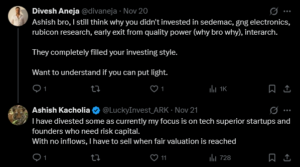
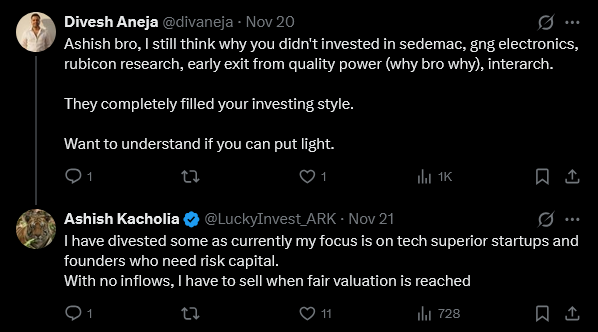
The revelation came in response to an investor who questioned why Kacholia had missed several promising listed companies, including Sedemac Mechatronics, GNG Electronics, Rubicon Research and Interarch Building Products, while also making an early exit from Quality Power Electrical Equipments.
Responding to the questions, Kacholia clarified that he had divested some of his listed investments because his current focus was on backing technology-driven startups and founders who need risk capital.
He added an important detail about his investment strategy: “With no inflows, I have to sell when fair valuation is reached.”
Why Is Kacholia Selling Listed Stocks?
Kacholia’s comments offer an interesting insight into the capital allocation decisions of a large investor.
Unlike institutional funds that receive regular inflows from investors, individual investors and investment entities may have to generate fresh capital by liquidating existing investments. Kacholia’s statement suggests that he is funding his startup investments through the proceeds from selling listed shares rather than relying on fresh capital inflows.
His approach also highlights the importance of opportunity cost. Even when an existing listed investment has further growth potential, an investor may decide to exit if another opportunity offers a more attractive risk-reward proposition.
In this case, Kacholia appears to believe that backing technology-oriented startups and entrepreneurs at an early stage offers an attractive opportunity to deploy risk capital.
A Shift From Listed Equities to Startup Investing
Kacholia has built a reputation for identifying relatively smaller companies with scalable business models, differentiated capabilities, technological advantages and the potential to become much larger businesses.
His interest in startups appears consistent with this broader investment philosophy. However, the nature of the opportunity is different.
In listed equities, investors generally buy shares of businesses that have already established operations, disclosed financial performance and a market valuation. Startup investing, on the other hand, involves backing businesses at an earlier stage, often before their business models have been fully established or their earnings potential has become visible.
Such investments can carry considerably higher risks, but successful startups can also generate substantial returns as they scale up.
Kacholia’s emphasis on founders is particularly noteworthy. His focus is not merely on technology but also on entrepreneurs who need risk capital to develop and commercialise their ideas.
What Does This Mean for His Listed Portfolio?
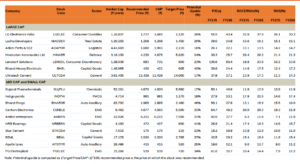
His comments provide a possible explanation for some of the portfolio exits and reductions that investors have been tracking.
It is important, however, not to interpret every reduction in his listed holdings as a negative view of the underlying company. A sale could reflect capital requirements, portfolio reallocation or the availability of more attractive opportunities elsewhere.
His reference to selling when a stock reaches fair valuation also suggests that valuation discipline remains an important consideration in his investment decisions.
For retail investors who closely track successful investors, this offers an important lesson: A good company and a good investment are not necessarily the same thing at every valuation.
Moreover, copying an investor’s portfolio without understanding the reasons behind an entry or exit can lead to incorrect investment decisions. An investor selling a stock may be acting for reasons that have little to do with the company’s future prospects.
The Bigger Takeaway
Kacholia’s latest comments reveal an interesting dimension of his investment philosophy. His focus is currently shifting from buying listed stocks to providing risk capital to technology-superior startups and ambitious founders.
It also underscores that even successful investors have to make capital allocation choices. When fresh money is not coming in, existing investments may have to be monetised to fund new opportunities.
For investors following Kacholia, the key takeaway is that his portfolio activity should be viewed in the context of his broader capital allocation strategy rather than interpreted simply as a bullish or bearish signal on individual stocks.
His latest statement reinforces a fundamental investment principle: capital should continuously move towards opportunities that offer the most attractive potential returns relative to the risks involved.
I’m not a financial advisor. The article reflects the views expressed in the quoted conversation, not an independently verified assessment of Kacholia’s current portfolio or startup investments.