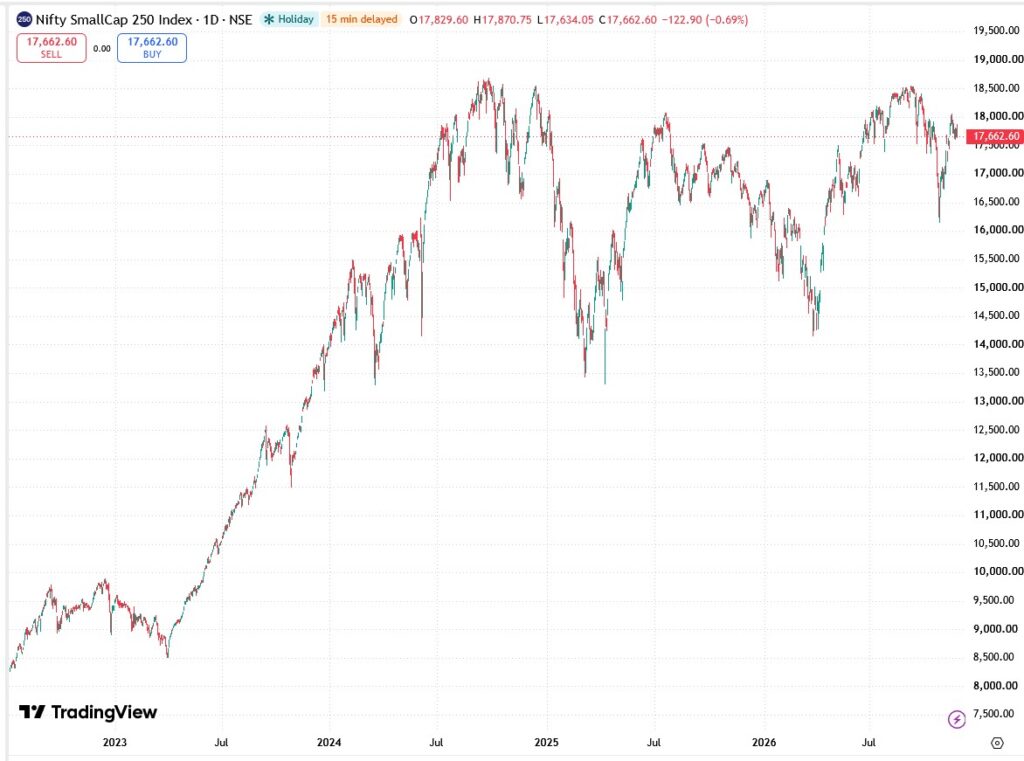
The recent rebound in the Indian stock market has prompted investors to question whether the opportunity to buy quality stocks at attractive valuations has already passed. However, Samit Vartak believes the answer depends on where investors look. According to him, the market continues to offer attractive opportunities, particularly in the smallcap segment, despite the sharp recovery from the October lows.
Vartak argues that the current market is a bottom-up stock-picking opportunity rather than one where investors should simply follow the broader indices.
Smallcap valuations remain attractive despite the recovery
One of the most interesting observations highlighted by Vartak is the extent of the valuation correction in smallcaps.
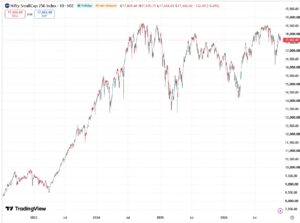
According to him, the smallcap price-to-book value (P/BV) ratio fell below the 25th percentile of its five-year historical range. Such depressed valuation levels had previously been witnessed only during the COVID-19 market crash.
The correction was particularly significant because corporate earnings continued to grow even as stock prices declined. This resulted in a substantial valuation de-rating, creating opportunities for investors willing to look beyond near-term market volatility.
Vartak also disclosed that in January, his own smallcap and microcap portfolio was trading at less than 15 times forward earnings, among the lowest valuation levels seen in nearly a decade.
More importantly, this valuation was against an expected profit growth of over 35% over the following two years.
This combination of relatively low valuations and strong projected earnings growth, according to Vartak, offered an attractive risk-reward opportunity.
He believes the subsequent 14% rebound in smallcaps does not fundamentally change the investment proposition. A recovery of this magnitude is not sufficient to erase the substantial valuation de-rating that had taken place earlier.
Largecap financials also offer attractive opportunities
Vartak believes the opportunities are not restricted to smallcaps.
Within the largecap universe, several sectors that have underperformed the broader market, particularly financials, are now trading at attractive valuations.
Large financial companies are available at some of their lowest price-to-book multiples in several years, potentially offering an attractive entry point for investors with a longer investment horizon.
The valuation correction in these businesses could provide an opportunity to accumulate quality companies at more reasonable prices.
Beware of expensive defence and power stocks
While Vartak sees attractive opportunities across several market segments, he cautions investors against indiscriminate buying.
Certain pockets of the market continue to command extremely expensive valuations, particularly defence, power equipment and power ancillary companies in the largecap and midcap segments.
Several stocks in these themes are trading at 80–90 times earnings despite expected growth rates of only 20–25%.
His message is clear: identifying a promising investment theme is only half the job. Investors must also identify companies within that theme that offer reasonable valuations.
A good business operating in an attractive sector does not automatically translate into a good investment if the stock price already discounts years of future growth.
Patient investors could generate alpha over the next 2–3 years
Vartak remains constructive on the market outlook and believes the odds favour patient investors over the next two to three years.
He advocates a buy-on-dips approach, suggesting that market corrections can be used to accumulate fundamentally sound businesses rather than trigger panic selling.
According to him, over a three-to-five-year investment horizon, earnings growth is the biggest driver of stock market returns. Corporate India is delivering earnings growth across a wide range of sectors, providing a supportive backdrop for long-term investors.
This makes the current environment particularly interesting for investors who can identify businesses with sustainable growth prospects, strong fundamentals and valuations that leave room for future returns.
The investment takeaway
Vartak’s assessment offers an important perspective amid the debate over whether the recent market rally has made stocks expensive again.
The broader market recovery should not be confused with a complete recovery in valuations. Several smallcap stocks continue to offer attractive valuations, while select largecap financials are also available at relatively depressed multiples.
However, investors should avoid chasing popular themes where valuations have already run far ahead of earnings growth.
The broader message is that the next phase of wealth creation may not come from simply buying the strongest-performing sectors or following the market indices. It could come from identifying undervalued businesses with strong earnings visibility and holding them patiently through market cycles.
For investors with a two-to-three-year investment horizon, Vartak believes the odds are increasingly favourable, provided they remain disciplined about valuations and focus on business fundamentals rather than short-term market movements.
Editorial note: The January portfolio valuation and earnings-growth estimates are presented as Samit Vartak’s disclosed figures and expectations, not as independently verified current valuations or guaranteed outcomes.