Far from being a passive stock picker who got lucky, the Big Bull was a rare market participant who mastered two vastly different skill sets: short-term trading and long-term value investing
There is an enduring romance in the stock market around the pure “buy-and-hold” value investor. The popular narrative suggests that real wealth is built solely by picking great companies, investing a modest sum, and letting compounding do the heavy lifting over decades.
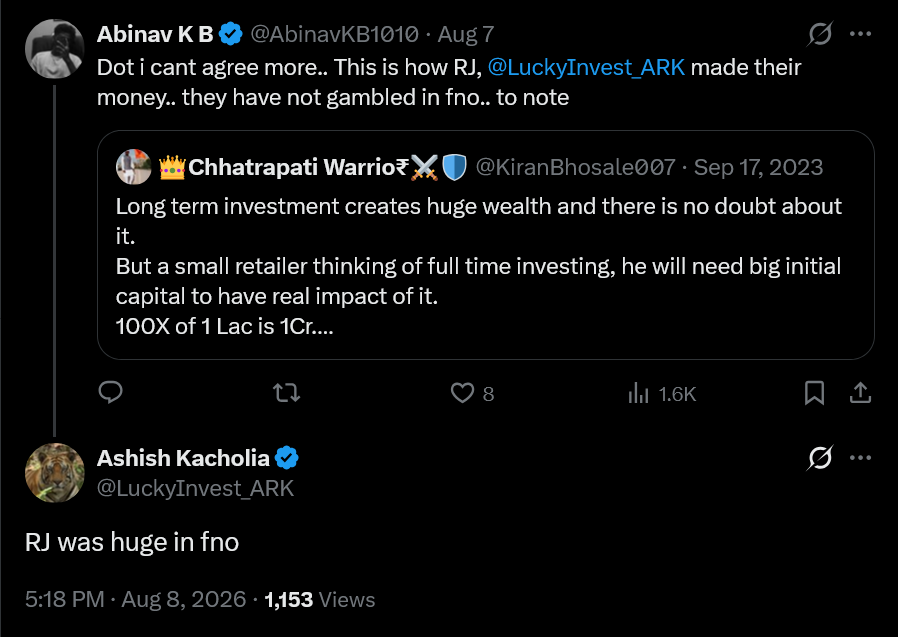
However, a recent exchange on X (formerly Twitter) sparked a reality check on how some of India’s biggest market legends actually amassed their fortunes—highlighting the critical role of capital generation and the often-misunderstood discipline of Derivatives trading.
The Retail Investor’s Dilemma: The Math of Capital
The conversation kicked off with a classic dilemma faced by everyday market participants. As commentator Kiran Bhosale pointed out, while long-term investing undoubtedly creates immense wealth, a small retail investor faces a fundamental hurdle: the starting line.
$$100 \times \text{₹1 Lakh} = \text{₹1 Crore}$$
$$100 \times \text{₹10 Crore} = \text{₹1,000 Crore}$$
“Long-term investment creates huge wealth and there is no doubt about it. But a small retailer thinking of full-time investing will need big initial capital to have a real impact…”— Kiran Bhosale (@KiranBhosale007)
A 100x return on a small sum yields a life-changing amount, but it rarely translates to generational, empire-building wealth. To make a massive absolute impact in long-term investing, you need massive initial capital.
So, how did legendary investors build that crucial initial nest egg?
The Debunked Assumption
When X user Abinav K B chimed in, assuming that market veterans like the late Rakesh Jhunjhunwala (RJ) and veteran investor Ashish Kacholia avoided Futures & Options (F&O) to build their capital—viewing derivatives as mere gambling—Kacholia himself stepped in to set the record straight.
@AbinavKB1010: "...they have not gambled in fno.. to note"
       │
       ▼
@LuckyInvest_ARK (Ashish Kacholia): "RJ was huge in fno"
Kacholia’s brief, direct response shattered a popular myth: Rakesh Jhunjhunwala was a massive player in the F&O market.
Trading as an Engine for Investing
Far from being a passive stock picker who got lucky, the Big Bull was a rare market participant who mastered two vastly different skill sets: short-term trading and long-term value investing.
-
The Trading Engine: Jhunjhunwala actively traded leveraged instruments (futures and options) using tight risk management, sharp macroeconomic foresight, and disciplined market timing.
-
The Investment Fuel: Instead of simply spending his trading profits, he systematically funneled those aggressive short-term gains into high-conviction, long-term equity bets (like Titan, Lupin, and CRISIL).
Trading wasn’t a distraction from his investing; trading was the catalyst that funded his investing.
Key Takeaways for Today’s Market Participants
-
Understand the Function of F&O: Derivatives are high-risk instruments often equated to gambling when misused by retail traders lacking risk management. However, in the hands of disciplined market experts, active trading serves as a capital-generation tool.
-
Capital Precedes Compounding: Compounding requires a sizable base to yield extraordinary absolute numbers. Finding a calculated, high-conviction method to scale your capital base early on is vital.
-
Respect Both Skill Sets: Short-term trading requires managing momentum, stop-losses, and leverage. Long-term investing requires patience, business analysis, and conviction. Blending both effectively is rare, but as Jhunjhunwala proved, immensely rewarding.
Trading is for those who can afford to take risk- certainly not for poor – poor people who lost capital in trading which was borrowed- are unable to repay loan and many people committed suicide