The online higher education opportunity in India is still in its infancy, but it is steadily gaining momentum thanks to supportive government policies, rising demand for professional upskilling and increasing digital adoption. Against this backdrop, brokerage Deven Choksey Research has initiated coverage on Jaro Institute of Technology Management & Research Ltd with a ‘BUY’ rating and a target price of ₹824, implying a potential upside of around 65% from the current market price of ₹498.
With a market capitalization of approximately ₹1,110 crore, Jaro has also attracted several well-known institutional investors. The company is promoted by founders holding 57.28%, while marquee investors include Abakkus Diversified Alpha Fund (2.28%), Singularity Growth Opportunities Fund (1.27%) and Subhkam Ventures (1.27%), reflecting growing institutional confidence in its business model.
Riding India’s Massive Online Education Opportunity
India’s higher education ecosystem remains significantly underpenetrated compared to global standards. The National Education Policy (NEP) 2020 aims to increase the Gross Enrolment Ratio (GER) in higher education to 50% by 2035, creating a long runway for companies operating in the online education ecosystem.
Unlike traditional educational institutions, Jaro does not own universities or campuses. Instead, it operates an asset-light technology platform that connects learners with leading universities offering online and executive education programmes.
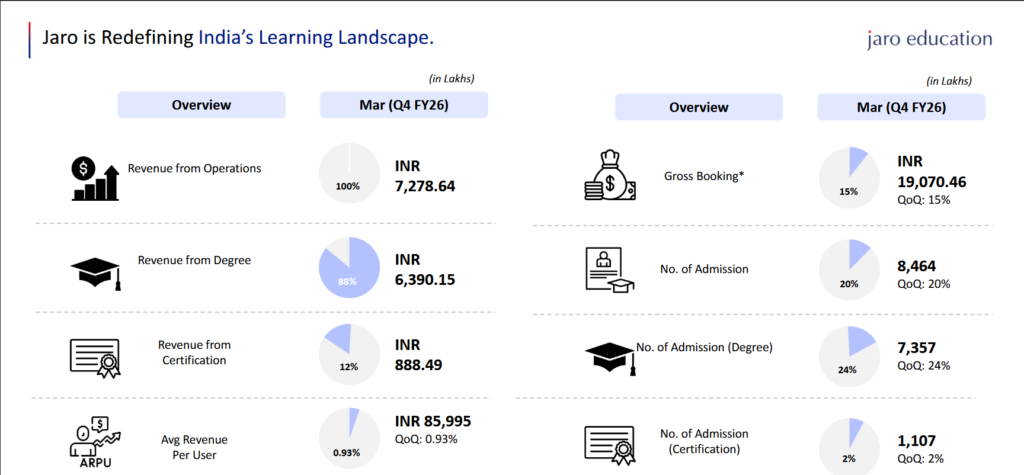
Today, the company has partnerships with 33 universities and facilitates over 32,000 annual enrolments, making it one of India’s largest university aggregation platforms.
As universities increasingly embrace online learning, Jaro stands to benefit directly through its revenue-sharing model without having to invest heavily in physical infrastructure.
Asset-Light Model Creates Powerful Economics
One of the biggest strengths highlighted by Deven Choksey Research is Jaro’s capital-efficient business model.
Unlike traditional education providers that require significant investments in campuses, faculty and infrastructure, Jaro primarily invests in technology, marketing and learner acquisition.
This results in several advantages:
- Minimal capital expenditure requirements
- Debt-light balance sheet
- Strong return ratios
- Significant operating leverage
- Healthy net cash position
As enrolments increase, much of the company’s cost base remains fixed, allowing profitability to expand at a faster pace than revenues.
This operating leverage is expected to become increasingly visible over the next few years.
Cash Flow Concerns May Be Temporary
One factor that has weighed on investor sentiment is Jaro’s relatively modest operating cash flow conversion.
However, Deven Choksey believes the market may be misunderstanding the nature of the business.
The company incurs learner acquisition costs upfront while revenues from long-duration educational programmes are recognised over several years. Receivables also remain outstanding for longer periods because programme fees are collected over the course duration.
These accounting characteristics temporarily suppress cash conversion despite healthy profitability.
As the enrolment base matures and growth stabilises, working capital intensity is expected to reduce, leading to stronger operating cash flows and potentially a rerating by the market.
Strong Financial Growth Expected
The brokerage projects an impressive growth trajectory over FY26-FY28.
Revenue
Revenue is expected to grow at a 25.2% CAGR, increasing from approximately ₹274 crore in FY26 to ₹429 crore in FY28.
Growth is expected to be driven by:
- Nearly 15% annual growth in student admissions
- Around 8% annual improvement in revenue per admission
- Higher-value programme mix
- Better fee realisations
EBITDA
Operating EBITDA is projected to increase from ₹72 crore in FY26 to ₹132 crore in FY28, representing a 35.3% CAGR.
EBITDA margins are expected to improve significantly from current levels to approximately 30.8%, reflecting the benefits of operating leverage.
Profit After Tax
PAT is expected to nearly double from ₹53 crore in FY26 to ₹102 crore by FY28, translating into an impressive 38.9% CAGR.
Such earnings growth, if achieved, would position Jaro among the faster-growing listed internet and education companies in India.
Valuation Leaves Room for Re-rating
According to Deven Choksey Research, the stock currently trades at roughly 11 times FY28 estimated earnings, despite its strong expected growth profile.
The brokerage believes the company deserves a valuation of around 18x FY28 earnings, resulting in a target price of ₹824 per share, representing a potential upside of 65%.
If management delivers on enrolment growth, margin expansion and improved cash conversion, the valuation discount could narrow meaningfully over the next few years.
Risks Investors Should Monitor
While the long-term outlook remains attractive, investors should remain aware of key business risks.
University disintermediation: Large partner universities could gradually build their own student acquisition capabilities, reducing dependence on Jaro’s platform.
Partner concentration: A meaningful portion of revenue comes from a limited number of university partners. Any loss of a major partnership, weaker student admissions or adverse changes in commercial arrangements could affect future growth and profitability.
Conclusion
Jaro Institute of Technology Management & Research represents an interesting play on India’s rapidly expanding online higher education market without the capital intensity associated with owning educational infrastructure.
Its asset-light business model, growing university network, scalable platform and expected operating leverage provide a compelling long-term investment case. With institutional investors such as Abakkus Diversified Alpha Fund, Singularity Growth Opportunities Fund and Subhkam Ventures already on the shareholding register, and Deven Choksey Research projecting robust earnings growth alongside a 65% upside, Jaro could emerge as one of the more closely watched small-cap education technology companies over the coming years.
As always, investors should monitor execution, cash-flow improvement and university partnerships before making any investment decisions.