Even as geopolitical tensions in West Asia and global macro uncertainties continue to weigh on investor sentiment, Carnelian Asset Management founder and CIO Vikas Khemani remains firmly optimistic about India’s long-term investment story. Speaking in an interview with NDTV Profit, Khemani highlighted the enormous opportunities emerging in pharmaceuticals, manufacturing and export-oriented businesses, arguing that periods of uncertainty often create the best opportunities for long-term investors.
GLP-1 Drugs: A Multi-Billion Dollar Opportunity
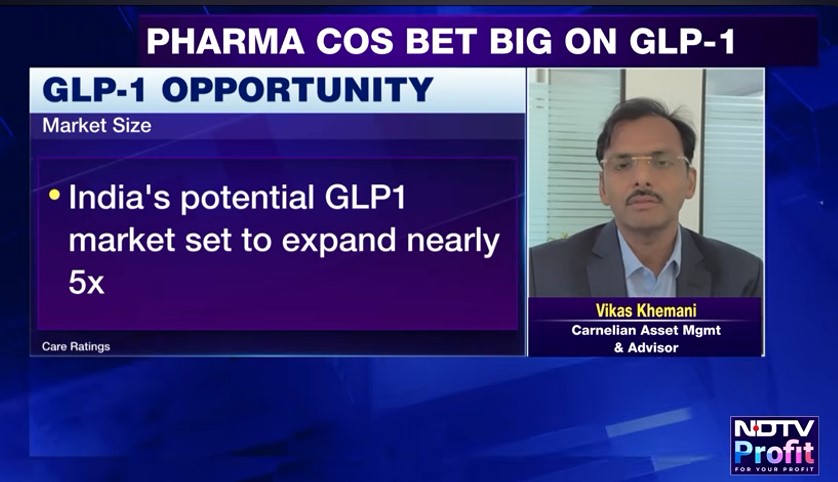
One of the biggest themes Khemani discussed was the rapidly expanding global market for GLP-1 drugs, which are transforming the treatment of obesity and diabetes.
According to him, the opportunity is large enough for multiple Indian pharmaceutical companies to participate, although not every player will ultimately succeed.
“The market is large, and companies with the right capabilities will capture significant growth,” he said.
He also pointed out an important secondary opportunity that is often overlooked. As global innovators divert manufacturing capacity towards GLP-1 therapies, insulin production capacity has become constrained. This creates another sizeable opportunity for Indian manufacturers, particularly companies with strong biologics capabilities.
Khemani remains positive on the pharmaceutical sector as a whole over the next five to ten years, with biologics and CDMO (Contract Development and Manufacturing Organisation) businesses emerging as key structural beneficiaries.
Why Only a Few Companies Will Win
While many companies are rushing to enter the GLP-1 market, Khemani believes only businesses with complete end-to-end manufacturing capabilities will enjoy sustainable competitive advantages.
He emphasised that companies controlling the entire value chain—from key starting materials (KSMs) to the finished formulation—are likely to be the biggest beneficiaries, especially in regulated international markets.
Such integrated manufacturing not only improves margins but also reduces dependence on imports and supply-chain disruptions, giving these companies greater control over their long-term growth.
India Is Handling Global Uncertainty Better Than Expected
The past eighteen months have been dominated by geopolitical conflicts, tariffs, supply-chain disruptions and now renewed tensions in West Asia.
Despite these headwinds, Khemani believes India has demonstrated remarkable resilience.
According to him:
- Economic growth has remained healthy.
- Corporate earnings have not suffered any major structural disruption.
- India’s long-term growth trajectory remains intact.
He compared the current environment to the uncertainty witnessed during the Russia-Ukraine conflict in 2022.
Although markets initially reacted negatively amid soaring oil prices and supply-chain disruptions, investor confidence eventually returned as macro conditions stabilised. Khemani believes the current situation could follow a similar trajectory, provided geopolitical tensions do not escalate significantly.
Manufacturing Remains India’s Biggest Structural Growth Story
While short-term market volatility often dominates headlines, Khemani stressed that investors should focus on long-term structural themes rather than temporary news flow.
His strongest conviction continues to be India’s manufacturing renaissance.
He believes the country is entering a multi-decade manufacturing upcycle supported by favourable government policies, global supply-chain diversification and improving export competitiveness.
The sectors he remains particularly optimistic about include:
- Pharma and biologics
- CDMO companies
- Auto and auto components
- Capital goods
- Defence and aerospace
- Specialty chemicals
- Export-oriented manufacturing businesses
According to Khemani, these industries are likely to produce many of India’s next generation of wealth creators.
FTAs and Currency Advantage Could Become Major Catalysts
Khemani identified two important developments that could significantly accelerate India’s manufacturing ambitions.
The first is India’s recent Free Trade Agreements (FTAs) with the European Union and several other countries, which together provide access to an addressable market estimated at nearly US$1.5 trillion on more favourable trade terms.
The second is India’s improving export competitiveness due to currency movements. He noted that the Indian rupee has depreciated by roughly 12–15% against several major trading partners, enhancing the competitiveness of Indian exporters.
The combination of improved market access and stronger export pricing could provide a powerful boost to domestic manufacturing over the coming decade.
Manufacturing’s Share of GDP Could Rise Sharply
India has long aimed to increase manufacturing’s contribution to GDP from roughly 15–16% to 20–25%.
Khemani believes the current global environment may finally provide the inflection point needed to achieve this ambitious target.
As multinational companies continue diversifying supply chains away from excessive concentration in any single geography, India appears well-positioned to emerge as one of the biggest beneficiaries.
Volatility Creates Multi-Bagger Opportunities
Perhaps Khemani’s biggest message for investors was that periods of uncertainty should not be feared—they should be utilised.
Instead of reacting to daily geopolitical headlines, investors should focus on identifying companies operating in powerful long-term structural themes.
According to him, market corrections often provide opportunities to accumulate high-quality businesses at attractive valuations.
“The themes don’t change. Manufacturing continues to remain a very powerful long-term opportunity. These are the times to identify businesses that can become the multi-baggers of the future,” he observed.
The Bottom Line
Despite global uncertainty, Vikas Khemani’s long-term outlook remains firmly constructive.
He sees India’s pharmaceutical sector benefiting from the GLP-1 revolution, biologics and CDMO opportunities, while manufacturing could enter a decade-long expansion supported by FTAs, improving export competitiveness and global supply-chain realignment.
For patient investors willing to look beyond short-term volatility, Khemani believes today’s uncertainty could lay the foundation for tomorrow’s multi-bagger investments.