Prashant Jain, one of India’s most respected fund managers, has made a fresh entry into Som Distilleries & Breweries Ltd. by acquiring a 1.22% stake, signalling confidence in the long-term prospects of the liquor maker despite the stock trading near its 52-week low. Interestingly, veteran investor Dolly Khanna, who earlier held a 1.49% stake, has either exited the company completely or pared her holding below the disclosure threshold, reflecting a changing shareholding pattern at a time when the company is navigating a difficult operating environment.
Prashant Jain Bets on a Contrarian Opportunity
Som Distilleries has been under pressure over the past year as weak consumer demand, operational disruptions and earnings contraction weighed heavily on investor sentiment. The stock has slipped to its 52-week low, making it one of the more beaten-down names in India’s alcoholic beverages space.
Prashant Jain’s investment suggests that the current weakness could represent an opportunity rather than a structural deterioration in the business. Historically, Jain has often invested in companies where near-term challenges have overshadowed long-term fundamentals.
What Went Wrong?
The company’s latest quarterly performance was impacted by multiple headwinds.
According to Chairman and Managing Director J.K. Arora, sales volumes declined primarily because of:
- Temporary licence-related disruptions at the company’s Bhopal manufacturing facility.
- Continued weak market demand in Karnataka, one of Som Distilleries’ largest operating markets.
- Higher input costs arising from the ongoing global commodity environment, which are expected to keep pressure on margins during the current financial year.
These issues resulted in lower production, reduced sales volumes and weaker profitability.
Uttar Pradesh Expansion Could Change the Growth Story
Despite the near-term challenges, management remains optimistic about the future.
The company is investing around ₹600 crore to establish a large integrated brewery and distillery in Uttar Pradesh, one of India’s largest alcohol consumption markets.
The project has already entered the trial production phase, while commercial operations are expected after successful completion of the testing process.
The new facility is expected to:
- Significantly increase production capacity.
- Improve logistics and supply efficiencies.
- Strengthen the company’s presence in North India.
- Reduce dependence on existing manufacturing locations.
- Support long-term volume growth.
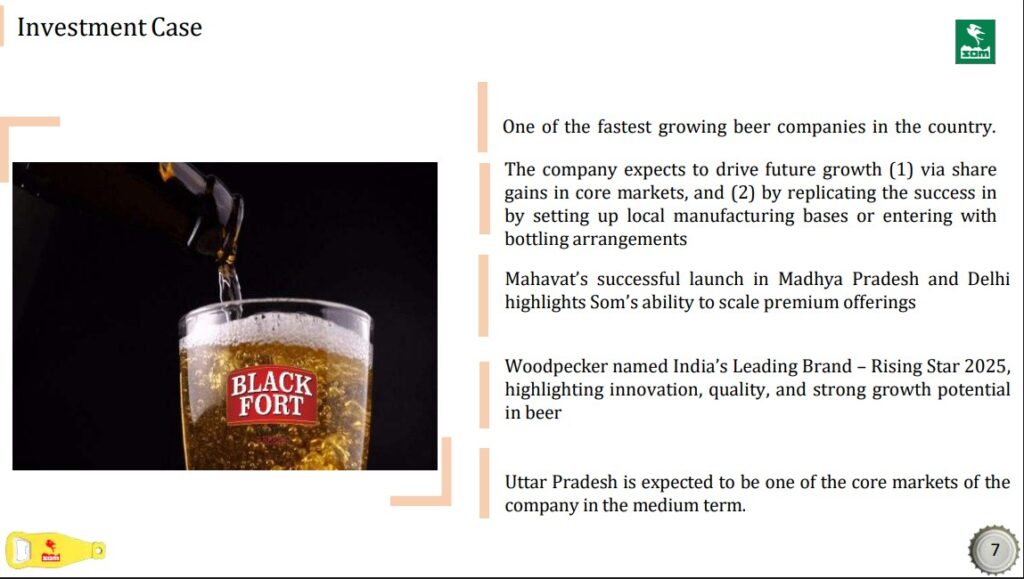
Management believes Uttar Pradesh could emerge as one of the company’s most important markets over the medium term.
One of India’s Fastest Growing Beer Companies
Despite recent setbacks, Som Distilleries continues to enjoy a strong position in the beer segment.
Its long-term strategy revolves around:
- Increasing market share in existing states.
- Entering new geographies through local manufacturing facilities and bottling partnerships.
- Expanding its premium product portfolio.
- Leveraging brand-led growth rather than competing only on pricing.
The company’s premium beer brand Woodpecker recently received recognition as India’s Leading Brand – Rising Star 2025, highlighting its growing acceptance among consumers.
Management also points to the successful rollout of its premium beer Mahavat in Madhya Pradesh and Delhi as evidence that the company can successfully scale premium offerings across multiple markets.
Mahavat Whisky: A New Premium Growth Driver
Som Distilleries is now extending the Mahavat brand beyond beer into the fast-growing premium whisky category.
The newly launched Mahavat Whisky has been positioned in the ₹1,000–1,100 price segment, targeting consumers seeking premium experiences.
The company describes the whisky as offering:
- A flavour profile combining pear notes, subtle smokiness and candied sweetness.
- A lingering woody and cocoa finish.
- Carefully selected grain spirits and matured malts aged in seasoned barrels.
- A premium identity inspired by royalty, leadership and individuality.
Initially launched in Bhopal, the whisky has already expanded into Madhya Pradesh, Delhi and Uttar Pradesh.
The premiumisation trend in India’s alcoholic beverage industry has been driving faster growth than the mass-market segment, making Mahavat an important strategic initiative for the company.
Near-Term Challenges Remain
While the long-term growth initiatives appear promising, investors should not ignore the immediate risks.
The company continues to face:
- Weak consumer demand in certain key markets.
- Margin pressure from elevated raw material costs.
- Execution risk associated with commissioning the Uttar Pradesh project.
- Competitive intensity in both beer and premium whisky segments.
Any further delays in the new plant or prolonged softness in demand could keep earnings under pressure over the next few quarters.
Changing Shareholding Signals Diverging Views
The contrasting actions of two well-known investors are noteworthy.
Prashant Jain’s fresh investment indicates confidence that the market may be over-discounting the company’s temporary challenges and underestimating the earnings potential once the Uttar Pradesh facility becomes operational.
On the other hand, Dolly Khanna’s apparent exit or reduction suggests that some investors may prefer to wait until operational performance begins to recover before turning constructive again.
Outlook
Som Distilleries currently presents a classic turnaround story. The business is grappling with temporary operational issues and a slowdown in demand, but management continues to invest aggressively for future growth through capacity expansion, premium brand building and geographical diversification.
If the Uttar Pradesh project is commissioned on schedule, demand normalises in key markets and premium brands like Mahavat continue gaining traction, the company could be well positioned for a recovery over the next few years. For investors, however, the stock remains a higher-risk proposition where execution over the coming quarters will determine whether today’s pessimism eventually turns into tomorrow’s opportunity.