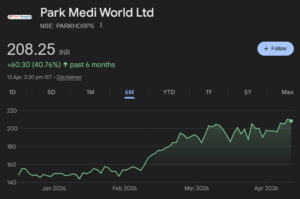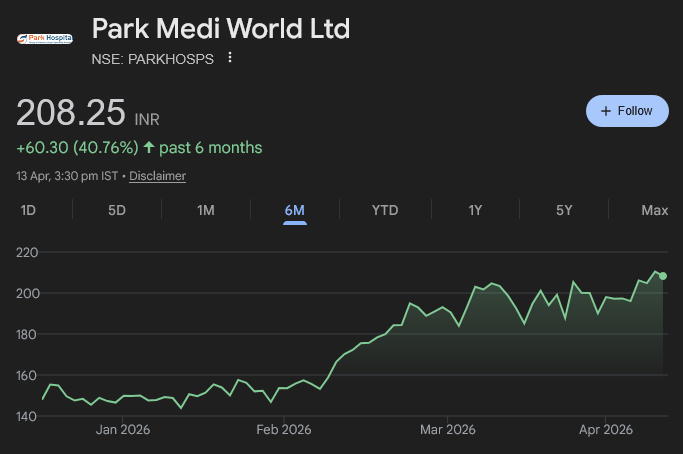
The recent investment by Vikas Khemani’s Carnelian Amritkaal Fund into Park Medi World signals rising institutional confidence in India’s healthcare growth story. The fund has acquired a 1.04% stake in the company, which currently commands a market capitalization of approximately ₹9,000–₹9,100 crore.
With promoter holding at ~82.8%, the company reflects strong promoter conviction—often considered a positive signal for long-term investors.
Business Overview
Park Medi World is one of the fastest-growing hospital chains in North India and is currently:
- 2nd largest private hospital network in North India
- Largest in Haryana
- Operating 14 multi-super specialty hospitals
- Total capacity of ~3,250 beds
- Offering 30+ specialty & super-specialty services
- Supported by 1,000+ doctors and 2,100+ nurses
The company primarily focuses on affordable healthcare delivery, targeting Tier-2 and Tier-3 markets while also benefiting from government healthcare schemes.
Investment Rationale: Why Smart Money is Entering
Carnelian’s investment likely reflects the following structural strengths:
1. Strong Operating Metrics
- EBITDA Margin: ~27%
- High operating leverage due to scalable hospital model
- Efficient cost structure compared to premium hospital chains
2. High Return Ratios
- ROCE: ~19–20%
- ROE: ~20–21%
These are strong indicators of capital efficiency in a capital-intensive industry like healthcare.
3. Dominant Regional Presence
- Strong foothold in North India, especially Haryana
- High bed occupancy driven by local dominance
Financial Performance & Fundamentals
Revenue & Profitability
- Annual Revenue: ~₹1,500+ crore
- Net Profit: ~₹250–₹270 crore
- EBITDA: ~₹380–₹420 crore
The company has shown consistent growth in both revenue and profitability, supported by:
- Increasing bed capacity
- Better occupancy rates
- Operational efficiencies
Margins
- EBITDA margins range between 24%–27%, which are competitive within the hospital sector
Return Ratios (Trend)
- ROE: ~20%
- ROCE: ~20%
These ratios indicate efficient capital allocation and improving profitability.
Balance Sheet Strength
- Debt-to-Equity: ~0.5–0.6
- Debt/EBITDA: ~1.7–1.8x
- Interest Coverage: ~8–10x
While the company carries moderate debt (typical for hospital businesses), improving cash flows and balance sheet discipline are strengthening financial stability.
Financial and Fundamental Profile
The investment by Carnelian comes at a time when Park Medi World’s financial metrics reflect a high-growth, high-efficiency business model.
Key Financial Metrics (FY25/Current)
Key Strengths
1. Scalable Business Model
The hospital chain model allows:
- Expansion through new hospitals and acquisitions
- Operating leverage as occupancy improves
2. Cost-Efficient Healthcare Delivery
Unlike premium players, Park Medi focuses on:
- Volume-driven growth
- Affordable pricing
- Government scheme participation
3. Strong Promoter Skin in the Game
- Promoter holding of ~82% ensures alignment with shareholders
Key Risks to Monitor
Despite strong fundamentals, investors should consider:
- Geographic concentration (heavy reliance on Haryana)
- Dependence on government schemes
- Lower ARPOB (Average Revenue Per Occupied Bed) vs premium peers
- Valuation risk in a high-growth phase
Conclusion
Park Medi World represents a structural healthcare growth story built on affordability, scale, and operational efficiency. The entry of seasoned investors like Vikas Khemani reinforces confidence in its long-term potential.
With:
- Strong margins (~27%)
- Healthy return ratios (~20% ROCE/ROE)
- Scalable hospital network
…the company is well-positioned to benefit from India’s rising healthcare demand.
However, investors should balance this opportunity with risks such as geographic concentration and dependence on government-led healthcare programs.