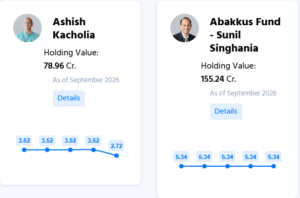
Ace investor Ashish Kacholia and his investment vehicle Surya Vanshi Pvt. Ltd. have exited their investment in Dhabriya Polywood Ltd., with veteran fund manager Sunil Singhania’s Abakkus Fund emerging as the buyer. The transaction marks a notable change in the shareholder register of the Jaipur-based micro-cap company, which has a market capitalization of around ₹485 crore.
While marquee investor movements often attract market attention, the bigger question for investors is whether Dhabriya Polywood’s business fundamentals justify a closer look.
A Niche Player in India’s Growing Building Materials Market
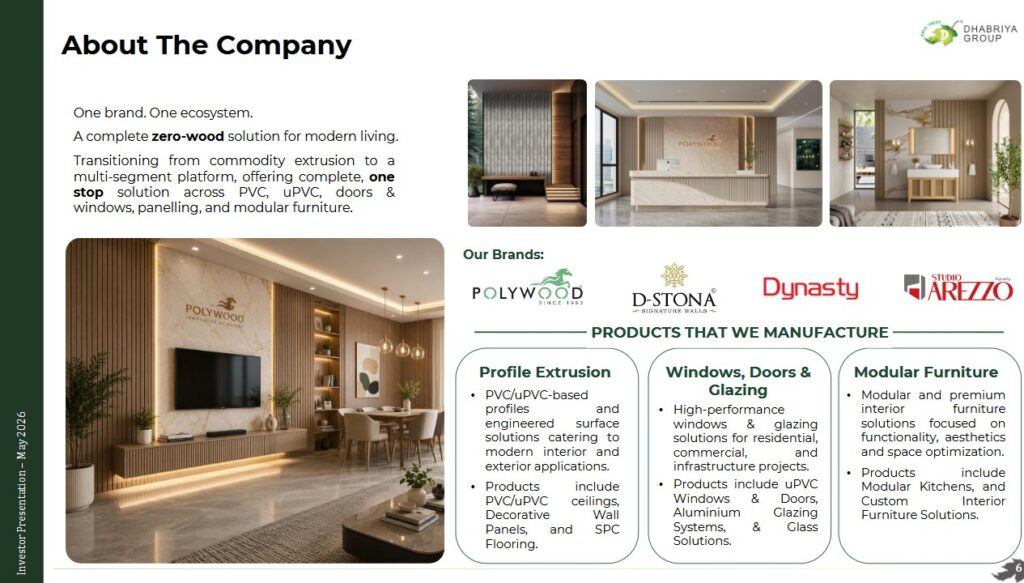
Dhabriya Polywood manufactures a wide range of PVC, uPVC and modular furniture products used in residential and commercial projects. Its offerings include modular kitchens, wardrobes, doors, windows, wall panels and furniture solutions that cater to both retail consumers and institutional customers.
The company has built relationships with several leading real estate developers, including DLF and Godrej, supplying modular furniture and interior solutions for large housing projects. Such institutional orders provide business visibility while helping the company diversify beyond retail demand.
Riding India’s Real Estate Cycle
India’s residential real estate market has witnessed a strong revival over the past few years, resulting in higher demand for interior products and home improvement solutions.
As premium housing launches increase, developers are increasingly opting for branded modular furniture and interior solutions that offer faster installation, superior quality and better durability. This structural shift could benefit organised manufacturers like Dhabriya Polywood.
The company’s focus on value-added products rather than commodity building materials also allows it to generate healthier margins.
Strong Financial Metrics
Despite being a micro-cap company, Dhabriya Polywood has delivered impressive operating metrics.
Some key highlights include:
- Market Capitalisation: ~₹485 crore
- Promoter Holding: 67.75%
- Return on Equity (RoE): 26%
- Price-to-Earnings (P/E): around 16x
The high promoter ownership reflects significant promoter skin in the game, while a RoE of 26% indicates efficient capital allocation. At approximately 16 times earnings, the valuation also appears relatively reasonable compared with several consumer and building-material peers, although investors should evaluate future earnings sustainability before drawing conclusions. Promoters continue to hold 67.75% of the company.
Operational Momentum
The company has also reported improving profitability in recent quarters, supported by better product mix and operating leverage.
Its recent financial performance reflected strong margin expansion, with EBITDA margins crossing 20%, highlighting management’s focus on profitability alongside revenue growth.
What Does the Shareholding Change Signal?
Ashish Kacholia has been associated with several successful small-cap investments over the years, making any change in his portfolio noteworthy. On the other hand, Sunil Singhania’s Abakkus Fund has built a reputation for identifying businesses with scalable growth potential.
While a change in ownership alone should never form the basis of an investment decision, the entry of another well-known institutional investor suggests continued interest in the company’s long-term prospects.
Ultimately, investors should focus less on who owns the stock and more on whether Dhabriya Polywood can continue expanding its presence in India’s growing organised furniture and building products market while maintaining its strong return ratios.
The Bottom Line
Dhabriya Polywood remains a relatively under-the-radar micro-cap operating at the intersection of India’s housing, home improvement and modular furniture themes. With strong promoter ownership, healthy return ratios, established relationships with leading real estate developers and improving profitability, the company offers an interesting business model.
However, given its small size and relatively limited market capitalization, investors should also remain mindful of liquidity risks and the higher volatility typically associated with micro-cap stocks. As always, investment decisions should be based on business fundamentals, valuation and individual risk appetite rather than investor shareholding changes alone.