Many investors dismiss Technical Analysis as little more than market noise. Traditional value investors often argue that charts, trend lines and price patterns cannot replace deep research into business fundamentals, management quality and earnings growth. Yet some of India’s most successful stock market veterans quietly use technical signals as an important part of their investing framework. One such investor is Ashish Kacholia.
Kacholia, widely respected for identifying emerging multibaggers early, has repeatedly spoken about the importance of combining conviction with timing. His views reveal that Technical Analysis, when used properly, is less about predicting the future and more about understanding probability, momentum and risk management.
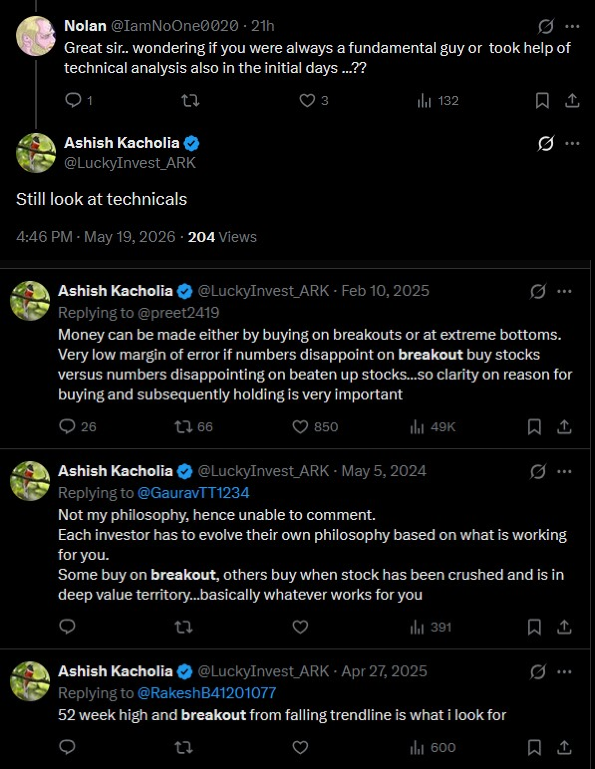
In a February 2025 interaction on X, Kacholia explained that wealth can be created through two very different approaches — buying stocks on breakouts or buying them at extreme bottoms.
“Money can be made either by buying on breakouts or at extreme bottoms,” he wrote. However, he also highlighted the key difference between the two approaches. According to him, breakout investing carries a very low margin of error if company numbers disappoint. In contrast, beaten-down stocks in deep value territory may already have pessimism priced in.
His statement underlines a critical lesson many investors ignore: every strategy has its own risks and rewards. Momentum investing can generate rapid gains when business performance supports the price action, but disappointments can trigger equally sharp corrections. Deep value investing, on the other hand, requires patience and the ability to withstand prolonged pessimism.
Kacholia further emphasized that clarity of thought is essential before buying any stock.
“So clarity on reason for buying and subsequently holding is very important,” he said.
That may be the most important takeaway from his investing philosophy. Whether one follows momentum investing, value investing or technical trading, conviction and discipline matter more than blindly copying strategies.
In another interaction during May 2024, Kacholia stated that every investor must evolve a philosophy suited to their own temperament and strengths.
“Some buy on breakout, others buy when stock has been crushed and is in deep value territory… basically whatever works for you,” he remarked.
This flexible mindset separates seasoned investors from rigid market participants. Successful investing is rarely about following a single textbook formula. Markets constantly evolve, and strategies that work in one phase may underperform in another.
Interestingly, Kacholia has also revealed the kind of chart setups he personally prefers. In April 2025, he succinctly stated:
“52 week high and breakout from falling trendline is what I look for.”
This insight offers a fascinating glimpse into his technical framework. Many retail investors instinctively search for stocks making new lows because they appear “cheap.” Kacholia, however, prefers strength over weakness. A stock trading near its 52-week high often signals institutional accumulation, improving fundamentals and strong market confidence.
Similarly, a breakout from a falling trend line can indicate the end of a long corrective phase and the beginning of a fresh uptrend. Such setups frequently attract momentum investors and institutional buyers, creating the potential for sustained rallies.
Importantly, Kacholia’s approach does not suggest blind reliance on charts alone. Instead, it reflects the idea that technical analysis can complement fundamental research. A fundamentally strong company entering a technical breakout phase may offer a higher probability opportunity than a weak business simply trading at low valuations.
Globally too, many legendary investors have respected price action. Market trends often reflect information, sentiment and institutional behaviour long before it becomes obvious in headlines or quarterly numbers.
The larger lesson from Kacholia’s comments is that there is no single “correct” way to make money in markets. Some investors succeed by buying panic and deep pessimism. Others succeed by buying strength and momentum. The key lies in understanding one’s own temperament, risk appetite and decision-making framework.
Ultimately, Technical Analysis may not predict the future with certainty, but in the hands of experienced investors, it can become a powerful tool for timing entries, managing risk and identifying emerging leadership in the market.