There are moments in the stock market when the consensus narrative becomes so overwhelmingly negative that even a fundamentally sound business can be priced as though its future is already over.
Paytm appeared to be one such case.
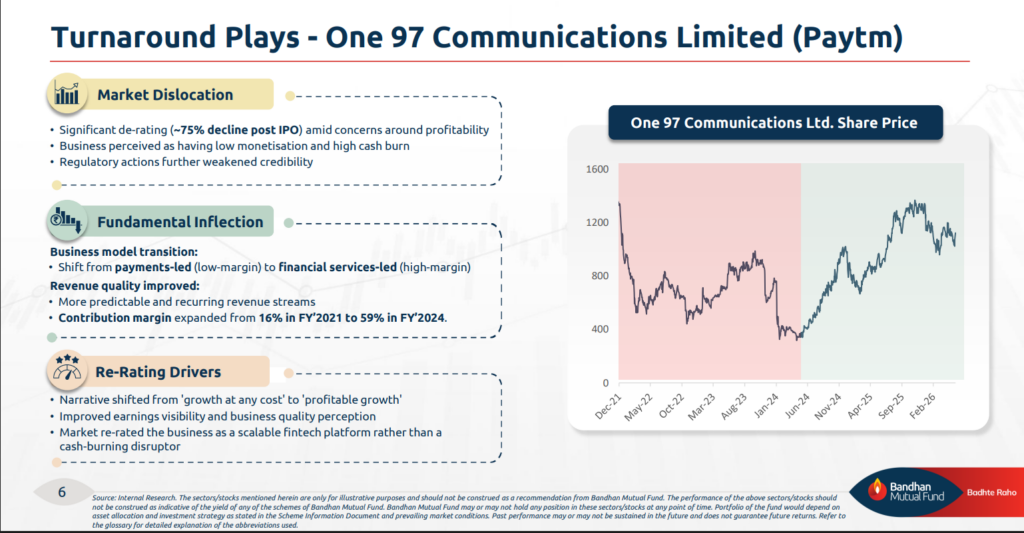
After its blockbuster listing in 2021, the stock went through a brutal de-rating. Regulatory setbacks, concerns around the Payments Bank, questions over profitability and intense investor scepticism pushed One 97 Communications, Paytm’s parent company, dramatically lower from its ₹2,150 IPO price. At its lows, the stock had lost well over three-quarters of its value from the listing price.
The sentiment became so weak that even Warren Buffett’s Berkshire Hathaway eventually exited its investment in Paytm at a substantial loss. Berkshire sold its remaining 2.46% stake in November 2023 at an average price of about ₹877 per share. (Moneycontrol)
But while the market was focusing on what could go wrong, one investor was willing to bet on what could go right.
That investor was Akash Bhanshali.
The contrarian bet
In the June 2024 quarter, Bhanshali emerged as a significant investor in One 97 Communications, holding roughly 1.21% of the company. Contemporary reports described the investment as a fresh entry into his portfolio at a time when Paytm was facing one of the most difficult periods in its history. (The Economic Times)
The timing was anything but comfortable.
The Reserve Bank of India’s action against Paytm Payments Bank had created enormous uncertainty around the business. The stock had already suffered a spectacular collapse, and the market was questioning whether Paytm could rebuild its payments franchise while simultaneously achieving sustainable profitability.
This is precisely what makes the investment interesting from a contrarian perspective.
Bhanshali was not buying Paytm after the business had become an obvious turnaround story. He was buying when the regulatory overhang was still fresh, sentiment was extremely poor and the market had largely written off the company’s ability to create significant shareholder value.
His investment of around ₹360 crore has subsequently multiplied dramatically in value. Based on recent market prices, the holding is now worth well over ₹1,200 crore, turning what looked like a high-risk contrarian bet into one of the more striking examples of turnaround investing in the Indian market.
The exact value fluctuates with the share price, but the broader message is clear: the investor who was prepared to buy when the market wanted to sell has been handsomely rewarded.
Even Buffett got the call wrong
Perhaps the most fascinating part of the Paytm story is the contrast between Bhanshali’s entry and Berkshire Hathaway’s exit.
Berkshire had invested in Paytm’s parent company years before its IPO. Its average acquisition cost was around ₹1,279.70 per share. When Berkshire eventually sold its remaining stake in November 2023 at around ₹877 per share, it realised a substantial loss on the investment. (The Economic Times)
This does not mean Buffett or Berkshire made an irrational decision.
On the contrary, Berkshire’s investment framework is fundamentally about assessing risk and expected returns, and the regulatory developments around Paytm materially changed the investment equation.
But markets do not reward investors merely for being right about the past. They reward investors who can correctly assess what happens next.
That is where the contrarian thesis becomes particularly interesting.
Bhanshali’s bet effectively said that Paytm’s problems, however serious, did not necessarily destroy the underlying value of its merchant network, consumer franchise, payments infrastructure, Soundbox business and financial-services ecosystem.
The market was looking at the damage.
The contrarian investor was looking at the possibility of recovery.
The turnaround is now visible in the numbers
Fast-forward to 2026 and Paytm’s financial trajectory looks very different.
For the June 2026 quarter, One 97 Communications reported a 79% year-on-year increase in net profit to ₹220 crore. Revenue from operations rose 28% to ₹2,448 crore, while EBITDA increased 54% to ₹203 crore, resulting in an EBITDA margin of 8.3%. GMV also increased 31% year-on-year.
Paytm itself highlighted the June-quarter performance as its highest-ever quarterly EBITDA. (Paytm Investor Relations)
These numbers matter because the Paytm investment thesis was never simply about having a large payments user base.
The bigger question was whether that user base could eventually be converted into sustainable economics.
That conversion now appears to be taking place.
Paytm’s merchant ecosystem, Soundbox business, financial-services distribution and UPI franchise are increasingly contributing to a business model where revenue growth can be accompanied by operating leverage.
And that is potentially much more powerful than simply growing transaction volumes.
The next catalyst: monetising UPI
The latest excitement around Paytm centres on a potential change to the economics of India’s UPI ecosystem.
UPI has historically operated with limited or zero merchant charges across much of the ecosystem, making it enormously valuable as a payments platform but difficult for payment companies to monetise directly.
That equation could be changing.
Recent reports suggest that a Merchant Discount Rate, or MDR, could eventually be applied selectively to larger merchants and/or higher-value UPI transactions. Media reports have indicated a possible MDR in the range of 25–40 basis points, although the final rate, transaction threshold and revenue-sharing structure remain subject to policy decisions.
This distinction is important.
MDR is not yet a guaranteed revenue stream for Paytm. The actual framework still needs to be finalised.
But if UPI transactions above certain thresholds become monetisable, Paytm could be one of the biggest beneficiaries because of its substantial presence across merchant acquisition, consumer payments and online payment processing.
Bank of America has estimated that MDR could create an annual revenue opportunity of roughly ₹8,000–11,500 crore for the broader UPI ecosystem. Its analysis suggests Paytm could see an 18–24% uplift to FY28–FY30 EPS under its assumptions.
That is why the market has suddenly started looking at Paytm differently.
The company that was once being valued primarily on whether it could survive is increasingly being valued on whether it can monetise its scale.
Brokerages are raising their targets
The changing narrative is also visible in brokerage estimates.
Bank of America Securities has retained its Buy rating on Paytm while raising its price target from ₹1,560 to ₹1,775. The brokerage sees strong momentum in Soundbox, merchant and consumer lending, UPI market-share gains, operating leverage and AI-led efficiencies as key drivers.
BofA also sees Paytm as one of the biggest potential beneficiaries of UPI MDR. It estimates that a restored wallet licence could eventually contribute another ₹100–115 crore to EBITDA.
JM Financial has gone further, raising its target from ₹1,500 to ₹1,950 while retaining its Buy rating. It estimates potential incremental revenue of ₹200 crore in FY27 and ₹440 crore in FY28 from UPI monetisation under its assumptions.
Meanwhile, Bernstein has reportedly raised its target to ₹2,200, taking its target above Paytm’s ₹2,150 IPO price. (Business Today)
The significance isn’t simply the numbers.
It is the direction of change.
The market is no longer debating whether Paytm can survive. It is debating how much Paytm can earn.
From regulatory casualty to operating leverage story
The most compelling aspect of Paytm’s turnaround may ultimately be operating leverage.
Payments businesses can have enormous transaction volumes but relatively thin economics. Once the underlying infrastructure, technology and merchant relationships are established, however, additional revenue can potentially flow through disproportionately to profits.
That is exactly what analysts are beginning to model.
BofA expects continued momentum in Paytm’s core businesses alongside margin expansion. JM Financial has similarly argued that UPI monetisation could have a high flow-through to EBITDA because much of the infrastructure is already in place.
This creates an interesting second phase for the Paytm story.
The first phase was about survival and stabilisation.
The second is about profitability.
The potential third phase is about monetisation and operating leverage.
If that third phase plays out, the valuation framework for Paytm could look very different from the one investors used during the stock’s darkest period.
What made the Bhanshali bet different?
Contrarian investing is often misunderstood.
It is not simply buying a stock because it has fallen 70%.
A stock can fall 80% and still be expensive if the underlying business is permanently impaired.
The real contrarian investor has to distinguish between a broken business and a temporarily broken narrative.
Bhanshali’s Paytm investment appears to have been based on the latter.
The market saw regulatory risk, uncertainty and a collapsed share price.
The contrarian thesis saw a large merchant ecosystem, a recognised consumer brand, a significant UPI presence, financial-services distribution and the possibility that management could eventually reshape the cost structure.
That distinction is crucial.
A contrarian investment works only when the investor is buying an asset whose future earning power is materially better than what the prevailing price implies.
Ashish Kacholia’s description captures the philosophy
Bhanshali has also earned recognition from fellow investor Ashish Kacholia, who has described him in highly complimentary terms as a “brilliant, clear-headed” and high-conviction investor known for taking big bets.
Whether every individual investment works is ultimately less important than the underlying philosophy.
High-conviction investing requires the willingness to act when the available evidence looks uncomfortable.
That is particularly difficult in public markets because investors are surrounded by information that reinforces the prevailing narrative.
When Paytm was under severe pressure, the easy decision was to stay away.
The difficult decision was to ask:
What if the market is extrapolating today’s problems too far into the future?
Bhanshali appears to have asked exactly that question.
But the turnaround is not risk-free
The Paytm story should not be interpreted as a guaranteed success.
The biggest near-term catalyst — UPI MDR — is still a policy-dependent opportunity rather than an established revenue stream. The eventual MDR rate, eligible transactions, merchant thresholds and revenue-sharing mechanism will determine how much economic value actually accrues to Paytm.
BofA itself has highlighted the risk that increased competition following UPI monetisation or a lower-than-expected MDR could reduce the upside.
There is also the question of valuation.
After its sharp recovery, Paytm is no longer the deeply distressed stock that Bhanshali bought in 2024. The market has already begun pricing in improving profitability and potential UPI monetisation. Paytm’s shares were trading around ₹1,618 on August 14, 2026, after recently reaching a 56-month high. (Business Today)
In other words, the easy part of the contrarian trade may already be behind investors.
The question now is whether earnings can catch up with expectations.
The bigger investing lesson
The Paytm saga offers a valuable lesson about how turnaround investing actually works.
The stock market often prices companies based on the narrative surrounding them.
When the narrative turns negative, investors can move from acknowledging genuine problems to assuming that those problems will permanently destroy the business.
That is where opportunity can emerge.
Bhanshali’s Paytm investment is a striking example because the purchase came when almost every obvious indicator was uncomfortable.
Regulatory uncertainty was high.
The stock had collapsed.
Large institutional investors had lost money.
Berkshire Hathaway had exited.
Yet the underlying franchise had not disappeared.
Two years later, Paytm is producing record quarterly EBITDA, reporting strong revenue growth and attracting increasingly bullish brokerage commentary. Its potential participation in UPI monetisation has given investors another reason to reassess its long-term earnings power. (Paytm Investor Relations)
The lesson is not that investors should blindly follow Bhanshali into Paytm.
Nor is it that Buffett was “wrong” and Bhanshali was “right” in some simplistic sense.
The more useful lesson is this:
The greatest contrarian opportunities often appear when the market is correct about the problems but wrong about their permanence.
Paytm’s transformation from one of India’s most heavily criticised listed fintechs into a company attracting fresh bullish price targets is a powerful reminder of that principle.
For Bhanshali, the bet was made when conviction was cheap and sentiment was expensive.
Now, as the stock moves back into the spotlight, the market is beginning to ask a very different question:
Was Paytm ever really a broken business — or was it simply a misunderstood turnaround waiting for the numbers to catch up?
Disclaimer: This article is for informational purposes only and is not investment advice. Brokerage price targets and UPI-MDR assumptions are estimates and can change materially. Investors should conduct their own research and assess valuation and risk before making investment decisions.