While Kacholia's track record proves the efficacy of riding momentum, executing this strategy requires extreme discipline.
In the world of value investing, market “bubbles” are usually treated like financial landmines—phenomena to be predicted, feared, and avoided at all costs. Yet, for veteran investor Ashish Kacholia, euphoria isn’t a threat; it’s an engine.
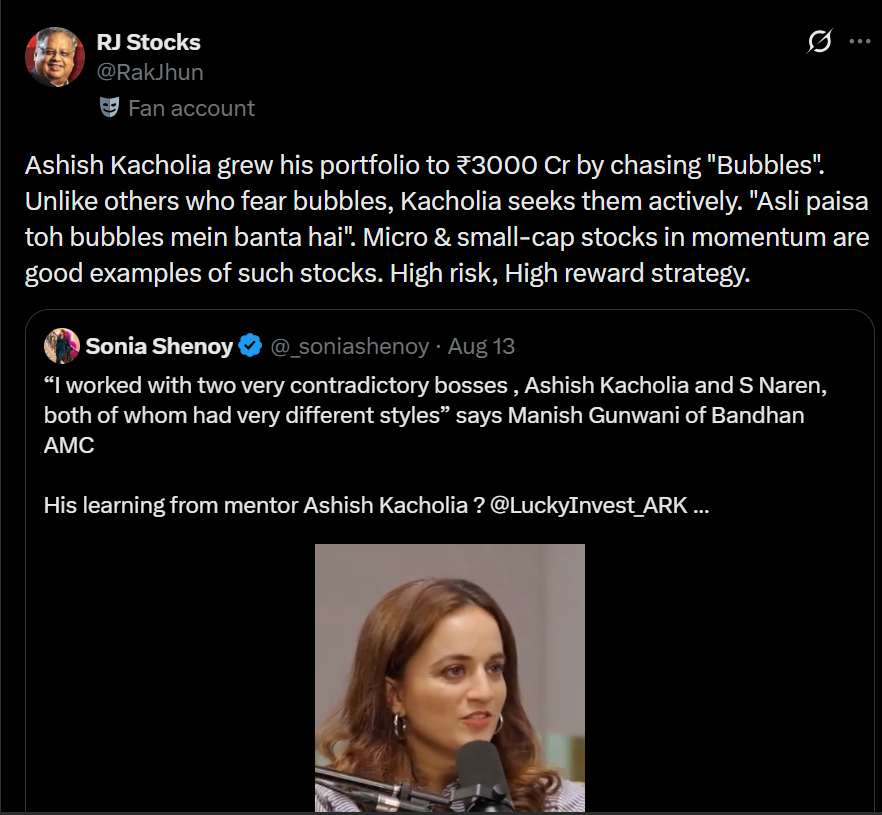
During a recent interview with Sonia Shenoy, Manish Gunwani, Head of Equities at Bandhan AMC, reflected on the contrasting wisdom of his two major mentors: Ashish Kacholia and S Naren. While both are giants in the Indian markets, their philosophies sit on opposite ends of the investing spectrum.
Highlighting his key takeaway from Kacholia, Gunwani distilled it into a single, punchy line:
“Asli paisa bubble mein hi banta hain.”(Real money is made in bubbles.)
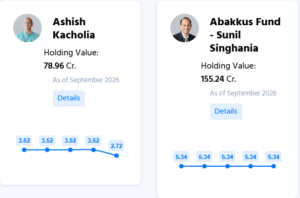
While conventional wisdom preaches safety in quiet, undervalued stocks, Kacholia grew his public portfolio to over ₹3,000 Crore by actively seeking out momentum—specifically in the micro and small-cap space—and riding the very waves others run away from.
The Anatomy of the “Bubble” Strategy
To the uninitiated, chasing market bubbles sounds like a recipe for financial ruin. However, in the high-stakes world of small and micro-cap stocks, momentum acts as a powerful catalyst.
Conventional Wisdom:  Low Risk → Moderate Returns (Seek Stability)
Kacholia's Approach:  High Momentum → Exponential Growth (Ride the Bubble)
-
Spotting Early Momentum: Micro-cap companies often trade with low liquidity and minimal institutional coverage. When a macro trigger, sector shift, or earnings explosion hits these stocks, liquidity surges, causing rapid price expansion.
-
Capitalizing on Multipliers: In established large caps, a “bubble” might stretch valuations by 30% to 50%. In high-growth small caps, an expanding valuation multiple combined with earnings growth can produce 5x, 10x, or 20x returns in a relatively short window.
-
Accepting the Asymmetry: The core philosophy rests on a high-risk, high-reward model. The losses on failing trades are capped at 100% (or cut earlier via risk management), but the upside on winning momentum plays can be multi-thousand-percent gains.
Lessons for Retail Investors
While Kacholia’s track record proves the efficacy of riding momentum, executing this strategy requires extreme discipline.
-
Timely Entry & Exit: The hardest part of riding a bubble isn’t getting in—it’s getting out before the drop. Investors following momentum must have strict exit frameworks rather than falling in love with the story.
-
Size Matters: Micro-cap stocks carry severe liquidity risks. Position sizing is critical so that an unexpected contraction in a single stock doesn’t wipe out portfolio gains.
-
Differentiating Noise from Catalysts: True bubble-worthy momentum often starts with genuine tailwinds—whether regulatory shifts, massive order book expansions, or industry turnarounds—before retail hype takes over.
Two Paths to Alpha
Manish Gunwani’s reflection underscores a foundational truth about the stock market: there is no single path to wealth creation.
While value managers like S Naren master the art of buying distress and waiting patiently for mean reversion, momentum masters like Ashish Kacholia show that capitalizing on market exuberance—when done with deep market insight—can yield staggering fortunes.