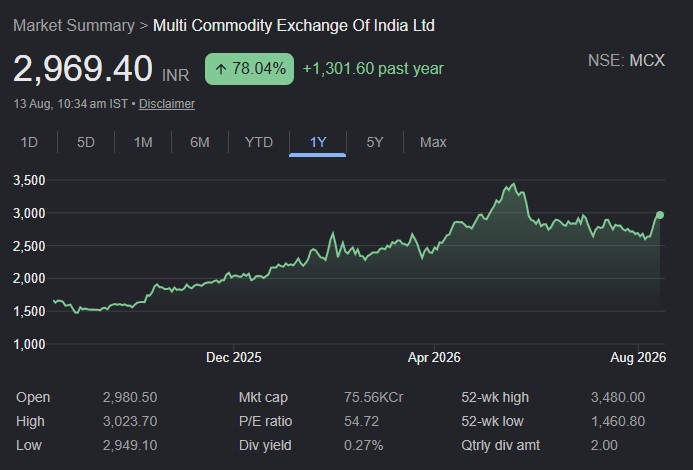
Multi Commodity Exchange of India (MCX) has emerged as one of the standout wealth creators in the Indian capital market, delivering an impressive 78% return over the past year and nearly 887% over five years. Despite this phenomenal run, global brokerages remain constructive on the stock, with UBS, Jefferies and JPMorgan seeing further upside, helped by a potentially important regulatory catalyst.
The trigger is SEBI’s proposal to allow Foreign Portfolio Investors (FPIs) to participate in physically settled, non-agricultural commodity derivative contracts on Indian exchanges. If implemented, the move could significantly broaden the participant base, improve liquidity and deepen India’s commodity derivatives ecosystem.
FPI participation could be a game changer
Commodity exchanges thrive on liquidity and participation. Allowing FPIs into a wider range of commodity derivatives could bring sophisticated global investors, traders and hedgers into India’s commodity markets.
For MCX, this is particularly significant because the exchange enjoys a near-monopoly position in India’s non-agricultural commodity derivatives market. Jefferies expects Indian commodity futures and options turnover to expand substantially over the next decade, with average daily turnover potentially growing threefold in futures and sixfold in options.
Higher participation can create a virtuous cycle: greater liquidity attracts more traders, increased trading activity lifts volumes, and higher volumes translate into stronger transaction revenue for the exchange.
Global brokerages turn bullish
The regulatory proposal has prompted a fresh wave of optimism among global brokerages.
UBS has upgraded MCX to Buy from Neutral and raised its target price to ₹3,800, up from ₹3,600. Based on the recent market price, this implies approximately 28% upside. UBS believes the recent correction has made the valuation more attractive, with the stock trading at a discount to its three-year average forward valuation.
JPMorgan has also upgraded MCX to Overweight and raised its target, citing the potential benefits from wider foreign participation in commodity derivatives. Jefferies has maintained its Buy view, with a ₹3,600 target, and sees multiple structural growth drivers for the exchange.
The convergence of views from three major global brokerages is noteworthy because it suggests that the MCX story is no longer merely about commodity-price volatility—it is increasingly becoming a structural financial-market growth story.
Strong earnings provide the foundation
The bullish thesis is also supported by MCX’s strong financial performance.
The exchange has benefited from elevated commodity prices and volatility, which tend to increase trading activity. MCX reported a sharp increase in earnings in FY26, with consolidated net profit rising 138% YoY, according to market data compiled after its FY26 results.
Jefferies expects MCX’s revenue to compound at around 20% between FY26 and FY29, while operating leverage could further improve profitability. The brokerage also identified several potential additional earnings drivers, including foreign participation, new products, weekly options, battery metals, chemicals, coal exchange opportunities and increasing retail participation.
The bigger opportunity: India’s financialisation of commodities
The most interesting aspect of the MCX story is the structural opportunity.
India is becoming increasingly financialised, with growing participation in equities, derivatives, mutual funds and other financial products. Commodities could be the next major segment to undergo this transformation.
MCX is well positioned to benefit because it already has an established ecosystem, strong liquidity, a broad product portfolio and dominant positioning in non-agricultural commodities.
The potential entry of FPIs could further internationalise India’s commodity derivatives market. It may also encourage the development of more sophisticated hedging products and attract institutional participants that have historically had limited access to Indian commodity derivatives.
But valuation remains an important consideration
The impressive returns delivered by MCX also mean that investors cannot ignore valuation risk.
The stock has already appreciated dramatically—887% in five years—and therefore expectations are high. Any slowdown in trading volumes, lower commodity volatility, regulatory changes, weaker-than-expected new-product adoption or a compression in valuation multiples could result in significant volatility.
The FPI proposal is also a regulatory proposal, not yet a guaranteed earnings outcome. The actual impact will depend on the final rules, eligible contracts, participation limits and the extent to which foreign investors ultimately use the facility.
Investors should therefore distinguish between the potential of the regulatory change and the certainty of its implementation.
Conclusion
MCX’s remarkable 78% one-year and 887% five-year return demonstrates how powerful the exchange’s growth story has already been. Yet the latest regulatory development suggests that the opportunity may be evolving rather than ending.
SEBI’s proposal to widen FPI participation could open a new avenue for volume and liquidity growth, while MCX’s dominant market position gives it a natural advantage in capturing the incremental activity.
With UBS targeting ₹3,800, Jefferies at ₹3,600 and JPMorgan turning Overweight, institutional sentiment has clearly strengthened.
The key question for investors is therefore no longer simply whether MCX has already delivered exceptional returns. It is whether India’s expanding commodity derivatives market, greater institutional participation and MCX’s near-monopoly position can sustain the next phase of earnings growth.
If the FPI reforms translate into materially higher volumes, MCX could potentially remain one of the key beneficiaries of India’s rapidly evolving commodity-market ecosystem. For investors, however, the substantial past appreciation makes valuation, execution and the pace of incremental volume growth critical factors to watch.