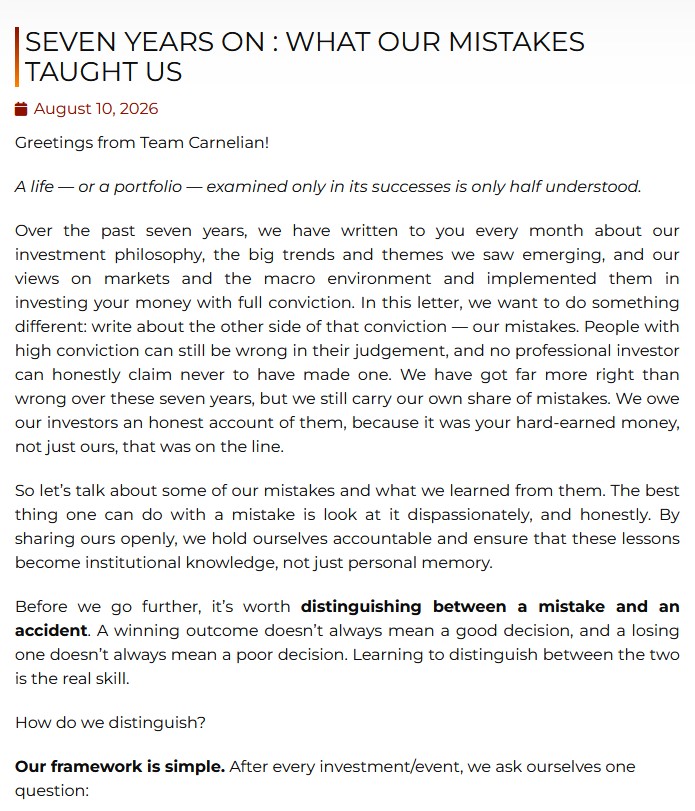
Vikas Khemani
“Once a mistake is recognized, correct it immediately.”
For investors, admitting that an investment thesis has gone wrong is often harder than identifying the mistake in the first place. Vikas Khemani, founder and CIO of Carnelian Asset Management, offers a refreshing perspective: even experienced investors can get their investment calls wrong, but the real test is how quickly they recognize the error and act on it.
Khemani has openly discussed some of his investment mistakes, including bets on Pakka, SpiceJet, Quick Heal, Polycab and Ola. What makes his reflections particularly interesting is that these were not necessarily irrational investments at the time they were made. Each had a specific investment rationale. The problem was that subsequent developments invalidated some of the assumptions behind the original thesis.
That distinction is crucial.
The investment thesis can be right — until it isn’t
A stock market investment is essentially a bet on a future outcome. Investors build a thesis around a company’s competitive advantages, industry opportunity, management capability, growth prospects and valuation.
But businesses evolve, competitive dynamics change and management execution can disappoint.
Khemani’s experience illustrates why investors must continuously test their original thesis against new evidence rather than becoming emotionally attached to a stock.
His message is simple: when the facts change, the investment decision must change too.
This is particularly important in businesses where the underlying opportunity may look attractive but execution, balance-sheet strength or management decisions ultimately determine shareholder returns.
Pakka: A compelling sustainability story needs execution
Pakka attracted investors because it offered exposure to the structural shift towards sustainable packaging. The company’s capabilities in moulded fibre and environmentally friendly packaging appeared well aligned with a world increasingly focused on reducing plastic usage.
The investment thesis therefore had several attractive elements: a large addressable market, sustainability tailwinds and the possibility of building a differentiated business.
But a good industry opportunity does not automatically translate into good shareholder returns.
If capacity expansion, execution or economics fail to develop as expected, the original thesis needs to be reassessed. For Khemani, Pakka became an example of why investors must distinguish between the potential of an industry and the actual ability of a company to monetise that opportunity.
SpiceJet: The difference between a good asset and a good investment
SpiceJet represents a very different kind of investment challenge.
Aviation is a business with enormous operating leverage. When capacity utilisation, yields and costs move in the right direction, profitability can improve dramatically. Conversely, operational disruptions, high costs and financial stress can quickly overwhelm the underlying opportunity.
The airline’s network, brand and operating capabilities may have offered an attractive turnaround opportunity. But turnaround investments are inherently dependent on execution and financial resilience.
The lesson is particularly relevant: a business can possess valuable underlying capabilities and still be a poor investment if the balance sheet and execution don’t allow those capabilities to generate adequate returns.
Quick Heal: Competitive advantages must withstand technological change
Quick Heal offered another interesting investment proposition. Cybersecurity is a structurally attractive market, with increasing digitalisation creating a long-term need for protection against cyber threats.
The investment thesis could therefore be built around a growing market and an established Indian cybersecurity brand.
But technology businesses have an additional risk: competitive advantages can erode faster than expected.
The cybersecurity landscape changes rapidly, and companies have to continuously invest in technology, products and distribution to remain relevant. An established franchise is valuable, but it cannot be treated as permanent.
For investors, the lesson is that a moat must be constantly tested rather than assumed.
Polycab: Even great businesses can be bought for the wrong reasons
Polycab is perhaps the most instructive example because the company possesses many of the characteristics investors typically seek: strong brands, distribution, manufacturing capabilities and exposure to India’s infrastructure and electrification opportunity.
Yet even a high-quality company can become a poor investment if the investor’s assumptions about growth, valuation or future earnings prove incorrect.
This reinforces an important investing principle: “great company” and “great stock” are not synonymous.
The quality of the business is only one part of the equation. The price paid and the future earnings trajectory matter just as much.
Ola: Betting on a transformation is inherently risky
Ola represents perhaps the most challenging form of investment thesis — backing a company undergoing a major transformation in a rapidly evolving industry.
Electric mobility has enormous long-term potential. India’s transition towards EVs creates a large opportunity across two-wheelers, batteries, charging infrastructure and related technologies.
But the size of the opportunity does not guarantee that every participant will emerge as a winner.
Competition, technology, manufacturing execution, capital requirements and customer adoption can all alter the outcome.
The Ola experience therefore highlights the difference between being right about an industry and being right about a particular company.
The bigger lesson: Don’t fall in love with your thesis
Perhaps the most valuable takeaway from Khemani’s reflections is not about any individual stock.
It is about investment discipline.
Investors often suffer from confirmation bias. Once they buy a stock, they unconsciously search for information that supports their original thesis while ignoring evidence that contradicts it.
Loss aversion makes the problem worse. Investors may hold on to a declining stock because selling would mean admitting that they were wrong.
Khemani’s philosophy turns this thinking around.
Recognising a mistake is not a failure. Refusing to correct it is.
The objective of investing is not to prove that one’s original prediction was correct. The objective is to maximise future returns while managing risk.
That means the relevant question is not:
“What did I originally think about this company?”
It is:
“Knowing what I know today, would I buy this stock today?”
If the answer is no, the investor needs to seriously consider exiting.
But a failed investment does not always mean a permanently broken company
There is another important dimension to Khemani’s thinking.
A company that disappoints investors today can potentially become an attractive investment again tomorrow.
The key is whether the core capabilities remain intact and whether the company has genuinely learned from its setbacks.
If a business addresses the problems that caused its deterioration, strengthens its balance sheet, improves execution, retains its competitive advantages and becomes available at a more attractive valuation, the investment thesis can be rebuilt.
In other words, the investor can be wrong about the timing or execution without necessarily being permanently wrong about the company’s long-term potential.
This creates an interesting investment framework:
Mistake → Exit → Monitor → Reassess → Re-enter if the thesis improves.
The willingness to revisit a former mistake is just as important as the willingness to sell it.
The real edge is intellectual honesty
Markets do not reward stubbornness. They reward adaptability.
Some of the best investors in the world have made significant mistakes. What differentiates them is their ability to separate their ego from their capital.
Khemani’s experience with Pakka, SpiceJet, Quick Heal, Polycab and Ola offers precisely that lesson.
The original thesis may have been based on sound reasoning. But when reality diverged from expectations, the investment decision had to change.
And that is perhaps the most important principle for investors:
You don’t have to be right all the time. You have to recognise when you are wrong — and act before a mistake becomes a permanent loss of capital.
At the same time, investors should not permanently blacklist a company simply because it once disappointed them. If its core capabilities survive, management learns from its mistakes, the business fundamentals improve and valuation becomes attractive, yesterday’s mistake can potentially become tomorrow’s opportunity.
In investing, the ability to change one’s mind is not weakness. It is a competitive advantage.

It is really important to identify mistake and correct at the earliest-but many people are not ready to accept that their assessment has gone wrong and become dogmatic- resulting in more capital loss.people need to reasess a company as and when positive or negative news comes-assess with an open mind and ready to accept and correct mistakes as soon as possible- then only they can become successful investors.