Zaggle Prepaid Ocean Services has suddenly become a battleground between near-term earnings concerns and a longer-term growth thesis.
The stock hit the 20% lower circuit on August 17 after the company reported a disappointing Q1 FY27 performance. Profit after tax fell 32.9% year-on-year to ₹17.5 crore, even as revenue from operations increased 27.5% to ₹423.3 crore. Adjusted EBITDA rose only 4%, while the EBITDA margin compressed to 8.2% from 10.1% a year earlier.
The sell-off continued into August 18, when the stock touched a fresh 52-week low of ₹154.40. From its August 2025 record high of ₹417.40, the decline has been dramatic.
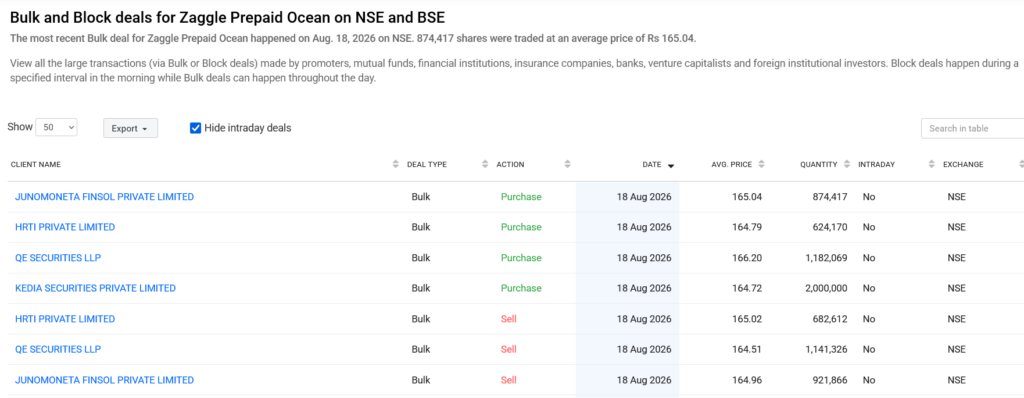
Yet, amid this pessimism, ace investor Vijay Kedia has bought 20 lakh shares of Zaggle at an average price of ₹164.72, investing approximately ₹32.94 crore. The purchase represents a 1.48% stake in the company.
That raises an obvious question: What does Kedia see that the market may be missing?
Q1 FY27: Strong revenue, weak profitability
At first glance, Zaggle’s Q1 numbers look contradictory.
Revenue grew a healthy 27.5% YoY, reaching ₹423 crore. But profitability moved sharply in the opposite direction, with PAT declining nearly 33%. Adjusted EBITDA margin also fell from 10.1% to 8.2%.
A key reason was the company’s transition and integration costs associated with its Dice acquisition. These included transaction expenses, one-time vendor payments and employee relocation costs. Importantly, revenue from Dice contracts was not captured in Q1 and is expected to start contributing from Q2 FY27.
This distinction is critical.
The market appears to have focused heavily on the earnings deterioration, while management is arguing that Q1 represents a period of investment and consolidation before the benefits of the acquisition begin flowing through the P&L.
Management has also maintained its FY27 consolidated revenue-growth guidance of around 40%, with standalone growth expected at 25–30%.
Why the market was bullish on Zaggle
Before the Q1 disappointment, the investment thesis around Zaggle was relatively straightforward.
The company operates in the corporate spend-management ecosystem, combining SaaS, fintech, prepaid cards, employee benefits, expense management, rewards and procurement-related solutions. Its platform connects corporates with payment networks, banks and enterprise software systems.
The bull case rests on three major pillars.
1. A large and underpenetrated market
Corporate expense management and digitalisation of business payments remain relatively underpenetrated areas compared with more mature global markets.
As companies increasingly move employee expenses, reimbursements, procurement, rewards and payments onto digital platforms, the addressable opportunity can expand significantly.
Zaggle has already built a meaningful ecosystem. The company says its platform has more than 3.9 million users and over 50 million cards issued, alongside thousands of corporate customers.
The significance of this ecosystem is greater than the headline card number suggests.
Every corporate relationship potentially creates opportunities to sell multiple products—from employee benefits and expense management to rewards, procurement and corporate cards.
That is where the cross-selling opportunity becomes important.
2. Switching costs can create a moat
One of the more interesting aspects of Zaggle’s business model is that its relationship with a corporate customer can become deeply embedded in the company’s workflows.
Once an organisation integrates expense management, employee benefits, cards, reimbursements, approvals and reporting into a single platform, switching providers isn’t necessarily as simple as changing a software subscription.
There are integrations with internal systems, employee workflows, financial processes and payment infrastructure to consider.
That creates a degree of customer stickiness.
The moat, therefore, isn’t necessarily a traditional network effect. It is more about workflow integration, data, distribution and switching friction.
If Zaggle can successfully use its existing corporate relationships to sell additional products, revenue per customer could rise without requiring the company to acquire an entirely new customer for every product.
Then came the Q1 shock
The problem for investors is that a high-growth stock is generally valued on future earnings, not merely current revenue.
When growth expectations are high, even a temporary margin disappointment can trigger a disproportionate correction.
That is effectively what happened with Zaggle.
The stock’s collapse reflects concerns that the company’s growth story could be accompanied by higher costs, margin pressure and weaker-than-expected earnings.
Analyst estimates have also been revised downward following the results. One compilation of analyst forecasts showed FY27 revenue expectations falling from ₹26.1 billion to ₹24.4 billion, while EPS estimates were reduced materially.
In other words, the market is not merely reacting to one bad quarter—it is reassessing the valuation and earnings trajectory attached to the business.
Ashish Kacholia: An important correction
The sell-off is particularly interesting because ace investor Ashish Kacholia is also a shareholder.
However, the commonly cited 3.88% figure appears incorrect based on the latest available June 2026 shareholding data.
Kacholia held approximately 29.03 lakh shares, equivalent to 2.16% of Zaggle, at the end of June 2026, down from 2.23% in March 2026.
So while the fall undoubtedly hurts the value of his investment, his exposure is closer to 2.16% of the company rather than 3.88%.
Interestingly, Kacholia actually trimmed his stake marginally during Q1 FY27, rather than adding to it.
This makes Kedia’s fresh purchase after the Q1 sell-off even more noteworthy.
Why Vijay Kedia’s purchase matters
Kedia’s 20-lakh-share purchase was executed around ₹164.72 per share, almost exactly around the level at which the stock was trading after its sharp correction.
It is tempting to interpret the transaction simply as a bet that Zaggle is “oversold.”
But there may be more to the investment thesis.
Kedia has historically shown an affinity for smaller companies with high growth potential, scalable business models and large addressable markets.
His portfolio includes businesses such as Affordable Robotic & Automation, TAC Infosec, TechD Cybersecurity and Exato Technologies. Recent portfolio data shows meaningful exposure to these technology and technology-enabled businesses.
His investment in Exato is particularly illustrative. In July 2026, Kedia Securities acquired an additional 3.58 lakh shares, taking the combined holding of Kedia Securities and persons acting in concert to 9.68%.
This suggests a broader pattern: Kedia is willing to back smaller, relatively asset-light businesses where he believes the addressable market and future growth can be significantly larger than current financials suggest.
Zaggle fits several elements of that framework.
The 40% growth question
Perhaps the biggest reason the Zaggle story hasn’t completely broken is management’s continued confidence in FY27.
The company has retained its target of approximately 40% consolidated revenue growth, with acceleration expected from Q2 as Dice revenues start getting recognised. Management has also indicated that revenue is seasonally weighted, with a larger proportion generated in the second half of the year.
If that guidance is achieved, Q1 could eventually be viewed as a weak starting quarter rather than evidence of a structurally broken business.
That is the central bull argument.
However, investors should distinguish between revenue growth and profitable growth.
A company can grow 40% while destroying shareholder value if the incremental revenue comes with excessive costs or poor cash conversion.
Therefore, the next few quarters will need to demonstrate that Zaggle can simultaneously:
- deliver the promised growth;
- integrate Dice successfully;
- recover margins;
- generate stronger operating cash flow;
- cross-sell more products to existing corporate customers; and
- convert its large user and card base into higher monetisation.
The real debate: Growth runway versus execution risk
The Zaggle story now comes down to two opposing narratives.
The bearish narrative is that Q1 FY27 exposed the risks of an expensive growth strategy. Profit declined sharply, margins compressed and the stock’s premium valuation has come under pressure. If earnings estimates continue to fall, the stock could remain under pressure despite strong headline revenue growth.
The bullish narrative is that the market has overreacted to a seasonally weak and transition-heavy quarter. Dice revenue is yet to contribute meaningfully, the company retains its 40% consolidated growth target, and its existing corporate ecosystem provides significant opportunities for cross-selling.
Kedia’s purchase suggests that at least one prominent investor sees sufficient long-term potential to buy aggressively after the correction.
Is Zaggle oversold?
That is ultimately a question of valuation and execution rather than simply price decline.
A stock falling 60% or more does not automatically make it cheap. But a sharp correction can create an attractive entry point if the underlying earnings power remains intact.
For Zaggle, the key question is therefore not:
“Has the stock fallen enough?”
It is:
“Can the company deliver the growth and margin recovery that investors were expecting before the correction?”
If management executes on its FY27 plan, integrates Dice smoothly and expands revenue through cross-selling, today’s depressed price could eventually look very different.
But if growth slows further and margins fail to recover, the recent correction could prove justified.
Bottom line
Zaggle’s 20% lower circuit is a reminder of how brutally the market can punish high-growth companies when earnings fall short of expectations.
Yet the underlying business has not suddenly disappeared.
The company still has a substantial corporate ecosystem, more than 50 million cards issued, a user base of over 3.9 million and a stated ambition to grow consolidated revenue by around 40% in FY27.
At the same time, investors should not ignore the warning signs: Q1 PAT fell 32.9%, margins contracted materially and analyst earnings expectations have been cut.
The most interesting development may therefore be Vijay Kedia’s ₹33-crore purchase at roughly ₹165 per share.
Kedia appears to be betting that Zaggle’s current pain is more about a temporary earnings reset and an oversold stock than a permanent deterioration in its business model.
Whether that contrarian bet pays off will depend on what Zaggle delivers over the next three quarters.
For now, Zaggle is no longer simply a high-growth story. It is a test of whether high growth, a potential moat and a large market opportunity can translate into sustainable, profitable execution.
Note: This article is for informational purposes only and should not be construed as investment advice. Shareholding and market data can change, and investors should independently verify company filings before making investment decisions.