India wants to attract foreign capital to finance its growth ambitions, deepen its capital markets and strengthen its position as one of the world’s most attractive investment destinations. Yet, a growing concern among market participants is that cumbersome compliance requirements, tax complexities and regulatory restrictions are making it unnecessarily difficult for overseas Indians to invest in their home country’s markets.
Two prominent market voices, ace investor Ashish Kacholia and fund manager Samir Arora, have highlighted these concerns, raising important questions about whether India’s regulatory framework is inadvertently discouraging genuine investors and contributing to the outflow of foreign capital.
Ashish Kacholia: NRIs Want to Invest, but the Process Is Discouraging Them
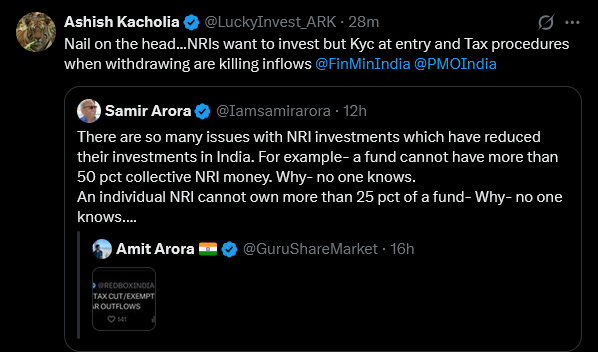
Ashish Kacholia, widely followed for his investments in emerging small- and mid-sized businesses, has pointed to the difficulties NRIs face when investing in India.
In a post addressed to the Finance Ministry and the Prime Minister’s Office, Kacholia endorsed the view that the combination of high taxes, uncertainty surrounding tax treatment and cumbersome compliance procedures is hurting investor sentiment.
His central concern is straightforward: NRIs are willing to invest in India, but the procedures involved in entering and exiting investments are discouraging them.
The problem begins with Know Your Customer (KYC) requirements. Investors may encounter documentation requirements, verification procedures and compliance formalities before they can even begin investing. The difficulties do not necessarily end once the investment is made. Tax documentation and procedures at the time of withdrawal or repatriation can create additional friction.
For an investor comparing opportunities across countries, ease of investing matters. If another market offers a more predictable and straightforward investment process, the additional effort involved in investing in India can become a meaningful deterrent.
Kacholia’s intervention highlights a crucial point: attracting capital is not merely about offering attractive growth prospects. It is also about making the investment process accessible, predictable and efficient.
Samir Arora Questions the Logic Behind NRI Investment Restrictions
Fund manager Samir Arora has raised a broader set of concerns about the regulatory framework governing NRI investments.
He argues that several restrictions appear difficult to justify from the perspective of genuine investors and has questioned whether the safeguards are proportionate to the risks they are intended to address.
Among the restrictions he highlighted are:
- The 50% collective NRI investment limit: Arora points to restrictions under which aggregate NRI investment in a fund may be capped at 50%.
- The 25% individual ownership limit: He also questions the restriction on an individual NRI holding more than 25% of a fund.
- Different treatment of overseas Indians: According to Arora, certain restrictions also apply to Overseas Citizens of India (OCIs), while foreign citizens without OCI status may be treated differently.
These restrictions raise questions about the rationale for distinguishing between investors based on their residential or citizenship status, particularly when the ultimate objective is to encourage legitimate investment in Indian assets.
The precise applicability of these limits depends on the investment vehicle and the relevant regulatory framework. Nevertheless, Arora’s broader argument is that restrictions should have a clear policy justification and should not impose disproportionate costs on genuine investors.
Is the Fear of Round-Tripping Discouraging Genuine Capital?
One possible justification for restrictions on NRI and OCI investments is the prevention of round-tripping.
Round-tripping refers to money originating in India being routed overseas and subsequently brought back into the country in a manner that disguises its origin, potentially to circumvent tax laws or other regulations.
Preventing such practices is a legitimate regulatory objective. Authorities must ensure that investment channels are not misused for tax evasion, money laundering or the concealment of beneficial ownership.
However, Arora questions whether broad restrictions on overseas Indians are the most effective way to achieve that objective.
His argument is that regulations designed to prevent misuse by a minority should not unnecessarily obstruct a much larger population of genuine investors. He also questions why the possibility of round-tripping should lead to restrictions that distinguish between NRIs, OCIs and other foreign citizens.
The policy challenge is to strike the right balance: prevent illegitimate transactions without making legitimate investments excessively complicated.
A risk-based framework that focuses on the source of funds, beneficial ownership, reporting obligations and suspicious transactions could be more proportionate than blanket restrictions, wherever the law permits such an approach.
Why This Matters for India’s Capital Markets
India’s long-term economic growth story depends partly on its ability to attract domestic savings and international capital. NRIs represent a potentially important source of investment because they often have financial, professional and family connections to India, alongside access to overseas earnings and savings.
Making it easier for them to participate in Indian capital markets could have several benefits.
1. A broader pool of long-term capital
Simpler investment procedures could encourage more overseas Indians to invest in Indian equities, mutual funds and other permitted financial instruments.
2. Greater investor confidence
Clear and predictable tax treatment reduces uncertainty. Investors are more likely to commit capital when they understand the rules governing entry, taxation, withdrawal and repatriation.
3. Better competitiveness with other markets
Investors compare not just returns but also compliance costs, administrative complexity and the certainty of regulations. An unnecessarily complicated framework can weaken India’s appeal even when its growth prospects remain attractive.
4. Stronger participation in financial markets
Greater participation by genuine overseas investors could broaden the investor base and support capital formation, although the actual impact would depend on the scale of additional inflows and prevailing market conditions.
Foreign Capital Outflows: Regulation Is One Part of the Story
The concerns raised by Kacholia and Arora come against the backdrop of recurring debates about foreign investor flows and India’s attractiveness as an investment destination.
However, it is important to recognise that foreign capital movements are influenced by several factors, including US interest rates, dollar movements, relative valuations, global risk appetite, corporate earnings and the performance of competing markets.
Tax uncertainty and cumbersome compliance procedures are therefore best viewed as potential structural impediments rather than the sole explanation for foreign capital outflows.
Even so, these are factors policymakers can address directly. India cannot control global interest rates or international risk sentiment, but it can review domestic procedures that unnecessarily increase the cost of investing.
What Should the Government Do?
The concerns raised by these market participants point towards a practical reform agenda.
Simplify NRI KYC. A streamlined digital verification system, wider acceptance of reliable overseas documentation and greater coordination among financial institutions could reduce repetitive compliance.
Make taxation more predictable. Investors should have clear guidance on tax deduction, documentation, refunds, capital gains and the procedures applicable when withdrawing or repatriating funds.
Review ownership and aggregate investment restrictions. The government and regulators could examine whether existing limits remain necessary, whether they are proportionate to identified risks and whether alternative safeguards could achieve the same objectives.
Apply risk-based safeguards. Strong monitoring of suspicious transactions and beneficial ownership can help prevent round-tripping without imposing unnecessary barriers on genuine investors.
Improve coordination among regulators. A more integrated process involving the relevant financial-market, banking and tax authorities could reduce duplication and make compliance easier to navigate.
Any reform would need to preserve safeguards against money laundering, tax evasion and regulatory circumvention. Simplification should mean smarter regulation, not the removal of legitimate oversight.
The Bigger Message: Ease of Investing Matters as Much as Returns
The observations of Ashish Kacholia and Samir Arora raise a fundamental policy question: should genuine overseas Indians face substantial administrative hurdles when they want to invest in the country?
India has a compelling long-term economic story, but investment decisions are also shaped by the ease of doing business and the predictability of regulation. Even investors who are optimistic about India’s prospects may hesitate if the process of investing, withdrawing and repatriating money is cumbersome or uncertain.
The objective should not simply be to attract more foreign capital at any cost. It should be to create a transparent, predictable and proportionate regulatory environment in which genuine investors can participate confidently while authorities retain the tools needed to prevent financial wrongdoing.
The message to policymakers is clear: if India wants to attract capital, it must ensure that the process of investing in India does not become a deterrent in itself.