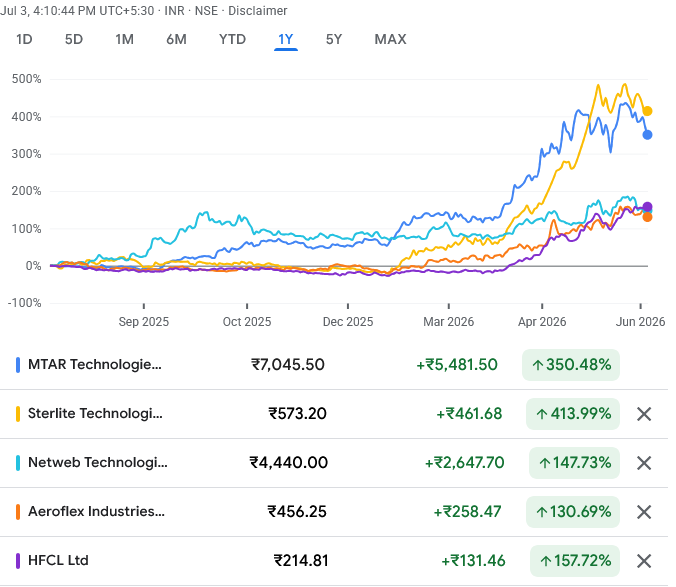
After delivering spectacular multibagger returns over the past year, several Indian AI and data centre-linked stocks, including MTAR Technologies, Sterlite Technologies, Netweb Technologies, Aeroflex Industries and HFCL, may be entering a phase where investors need to exercise greater caution.
The trigger is not company-specific but a growing global debate over whether the artificial intelligence investment boom is beginning to resemble a bubble.
Michael Burry Sounds the Alarm
Renowned investor Michael Burry, best known for predicting the 2008 global financial crisis, has once again issued a stark warning on market excesses.
Burry recently described the ambitious plan by Samsung Electronics and SK Hynix to invest more than $500 billion in developing an AI hub as the “Beginning of the End” for the current AI investment cycle.
While he did not suggest that artificial intelligence itself lacks long-term potential, his comments imply that excessive capital allocation and euphoric investor expectations could lead to significant value destruction if returns fail to justify the massive investments being announced.
The warning has reignited concerns that valuations across global AI-related companies may have run well ahead of fundamentals.
Indian AI Stocks Have Been Massive Wealth Creators
India’s AI, electronics, networking and data centre ecosystem has become one of the biggest themes in the stock market.
Companies such as MTAR Technologies, Sterlite Technologies, Netweb Technologies, Aeroflex Industries and HFCL have seen sharp re-ratings as investors rushed to capitalize on themes such as AI infrastructure, data centres, high-speed networking, semiconductor manufacturing and defence electronics.
Several of these stocks have delivered multibagger returns, with valuations expanding rapidly as investors priced in years of future growth.
While the long-term opportunity remains substantial, history suggests that even the strongest structural themes often experience sharp corrections when optimism becomes excessive.
CLSA Also Sees Signs of an AI Bubble
Adding weight to the cautionary view, a CLSA strategist has also suggested that the global AI trade is showing characteristics of a bubble.
According to the brokerage, the AI narrative could begin to unwind if investor expectations become unrealistic or capital spending fails to generate commensurate earnings growth.
Interestingly, CLSA believes that India could actually emerge as a beneficiary if such a rotation takes place.
Over the past couple of years, a significant amount of foreign institutional investor (FII) capital shifted from India toward markets such as South Korea and Taiwan, where AI and semiconductor companies became the biggest beneficiaries of global fund flows.
If enthusiasm for the AI trade moderates, some of that capital could find its way back into Indian equities.
India May Benefit From FII Rotation
Although Indian equities continue to trade at premium valuations compared to many emerging markets, CLSA argues that global investors may still view India favourably.
One reason is the limited availability of large, liquid emerging markets offering strong structural growth, political stability and relatively resilient corporate earnings.
Should global AI-linked markets witness profit booking, India could become an attractive alternative destination for foreign capital despite its higher valuations.
Such a shift would potentially benefit broader sectors including banking, capital goods, manufacturing, infrastructure and domestic consumption rather than only AI-focused companies.
Long-Term Story Remains Intact, But Valuations Matter
None of this necessarily means the AI revolution is ending.
Artificial intelligence is widely expected to transform industries over the coming decade, driving demand for computing infrastructure, networking equipment, semiconductor manufacturing and data centres.
However, market history repeatedly shows that revolutionary technologies often experience periods of excessive optimism followed by painful corrections before sustainable long-term winners emerge.
The dot-com boom of the late 1990s is perhaps the best-known example. While the internet ultimately transformed the global economy, many highly valued companies suffered steep declines when expectations outpaced business realities.
A similar pattern cannot be ruled out in today’s AI market.
Better Safe Than Sorry?
For investors sitting on substantial gains in AI and data centre-related stocks, this may be an appropriate time to reassess portfolio risk rather than chase momentum.
The long-term investment case for AI remains compelling, but elevated valuations leave little room for disappointment.
Rather than attempting to predict the exact peak, investors may consider focusing on companies with strong balance sheets, visible earnings growth and reasonable valuations, while avoiding excessive concentration in stocks that have already witnessed extraordinary rallies.
As Michael Burry’s warning and CLSA’s cautious stance indicate, the AI story is unlikely to disappear, but the market’s expectations may eventually need to come back to earth.
For investors, the old market adage may be particularly relevant: it is often better to be safe than sorry when enthusiasm turns into euphoria.